
The drone industry has no shortage of innovation. Airframes are getting lighter. Software is getting smarter. Autonomy capabilities are evolving rapidly. Across both defense and commercial markets, pressure to increase production is growing.
And it’s growing fast.
The Pentagon has publicly stated its goal of rapidly expanding low-cost autonomous systems under initiatives such as Replicator, while Ukraine’s drone manufacturing sector has scaled from thousands of units annually to millions in just a few years. NATO countries are simultaneously accelerating domestic UAV production capacity amid growing concerns around supply chain resiliency and manufacturing readiness.
But as many manufacturers are beginning to discover, building an impressive drone prototype and manufacturing thousands of repeatable, reliable systems are two very different challenges.
The real bottleneck in drone manufacturing is increasingly becoming process control.
At low production volumes, skilled technicians can compensate for a surprising amount of instability. Engineers are heavily involved on the floor. Manual adjustments are manageable. Production schedules are forgiving. Small inefficiencies remain hidden.
Scale changes everything. Processes that worked perfectly for 20 units can begin breaking down at 2,000.
The challenge is that many UAV production systems were never originally designed for sustained high-volume manufacturing. What worked in prototype or low-rate production environments can become unstable very quickly once governments and defense organizations begin demanding thousands of units per month instead of hundreds per year.
And so, variability compounds. Bottlenecks emerge. Quality drifts. Rework increases. Delivery timelines tighten. Suddenly, the manufacturing process itself becomes just as important as the drone design. This transition is happening across the industry right now, particularly as defense organizations push for larger-scale domestic UAV production capabilities.
And many manufacturers are finding themselves caught in an awkward middle ground. Their production environments have become too complex for highly manual workflows, but they have not yet fully transitioned into stable, industrialized manufacturing systems.
That gap is where process control becomes critical.
Key Insights
Importantly, process control in drone manufacturing extends far beyond PLCs, sensors, or robotics. It is really about consistency. Repeatability. Synchronization. Traceability. Stability under production pressure.
In composite-heavy UAV manufacturing environments, even small variations can create major downstream problems. Inconsistent heating cycles, uneven pressure distribution, material handling damage, operator-dependent forming, curing variability, or timing mismatches between operations can all introduce instability into the process.
At prototype volumes, those issues may be manageable. But at scale, they become expensive.
A slightly inconsistent forming process may not immediately appear catastrophic during low-rate production. But over time, inconsistencies begin accumulating across the manufacturing environment. Scrap rates rise. Assembly tolerances drift. Components fit differently from one batch to the next. Production slows as operators spend more time troubleshooting and compensating manually for variability elsewhere in the line.
In defense manufacturing environments, the consequences can become even more serious.
Missed delivery schedules can impact larger procurement timelines. Poor repeatability can create qualification headaches. Quality drift can introduce inspection failures or force expensive rework cycles. A production line that depends heavily on operator “feel” rather than repeatable process control becomes extremely difficult to scale reliably under pressure.
And pressure is exactly what the drone industry is now facing.
In the United States, defense leaders have repeatedly warned that Western drone production capacity remains insufficient for long-duration conflict readiness. At the same time, global military drone spending is projected to grow significantly over the next decade, placing additional pressure on manufacturers to scale quickly while maintaining quality and traceability standards.
And so, the focus is no longer simply on developing advanced UAV platforms. It is on building sustainable industrial capacity capable of supporting long-term production, surge manufacturing, and secure supply chains.
That shift matters.
For years, portions of the drone supply chain relied heavily on overseas manufacturing and low-cost labor models. But geopolitical instability, supply chain disruptions, export restrictions, and growing national security concerns have forced manufacturers to rethink that approach.
Domestic manufacturing is now becoming a strategic priority. But domestic manufacturing also introduces a difficult reality: labor availability.
Important Considerations

Aerospace and defense manufacturers across North America are already facing ongoing skilled labor shortages, particularly in advanced manufacturing and composite processing roles. As UAV production targets continue increasing, many manufacturers are realizing that scaling labor-intensive production models may simply not be sustainable long term.
Many manufacturers are discovering that scaling production using highly manual processes is becoming increasingly difficult in North America and Europe. Skilled manufacturing labor remains difficult to find. Experienced composite technicians are in short supply. Training new operators takes time. And as production ramps, dependency on tribal knowledge creates significant operational risk.
“Manufacturers are realizing that scaling drone production is not simply about adding more people to the floor,” says Alex Edge, Macrodyne’s Senior Business Development Manager for Global Markets. “At a certain point, manual processes stop being sustainable. Stable production requires stable processes.”
That is one of the major reasons automation is becoming such an important conversation within the UAV manufacturing sector.
Not because manufacturers are trying to eliminate workers, but because they are trying to stabilize production in an environment where labor shortages, production pressure, and quality expectations are all increasing simultaneously.
The most valuable automation is often not the flashiest.
The industry conversation frequently focuses on futuristic concepts such as fully autonomous factories or robotic assembly lines. In reality, many of the most meaningful gains come from much more practical automation improvements:
- Repeatable forming cycles
- Closed-loop force and motion control
- Consistent thermal management
- Automated material handling between operations
- Synchronized production flow
- Recipe-driven processing
- Integrated quality monitoring
- Reduced operator dependency
- Traceable production data
- Safer material handling environments
These systems help reduce variability before it spreads through the manufacturing environment. They also allow manufacturers to scale production without scaling chaos.
“Automation is often misunderstood as a labor replacement strategy,” says Jeff Walsh, Macrodyne Director of Business Development. “In reality, the biggest benefit is process stability. When production volumes increase, consistency becomes critical. Automation helps manufacturers keep production moving predictably.”
Scaling Exposes Everything
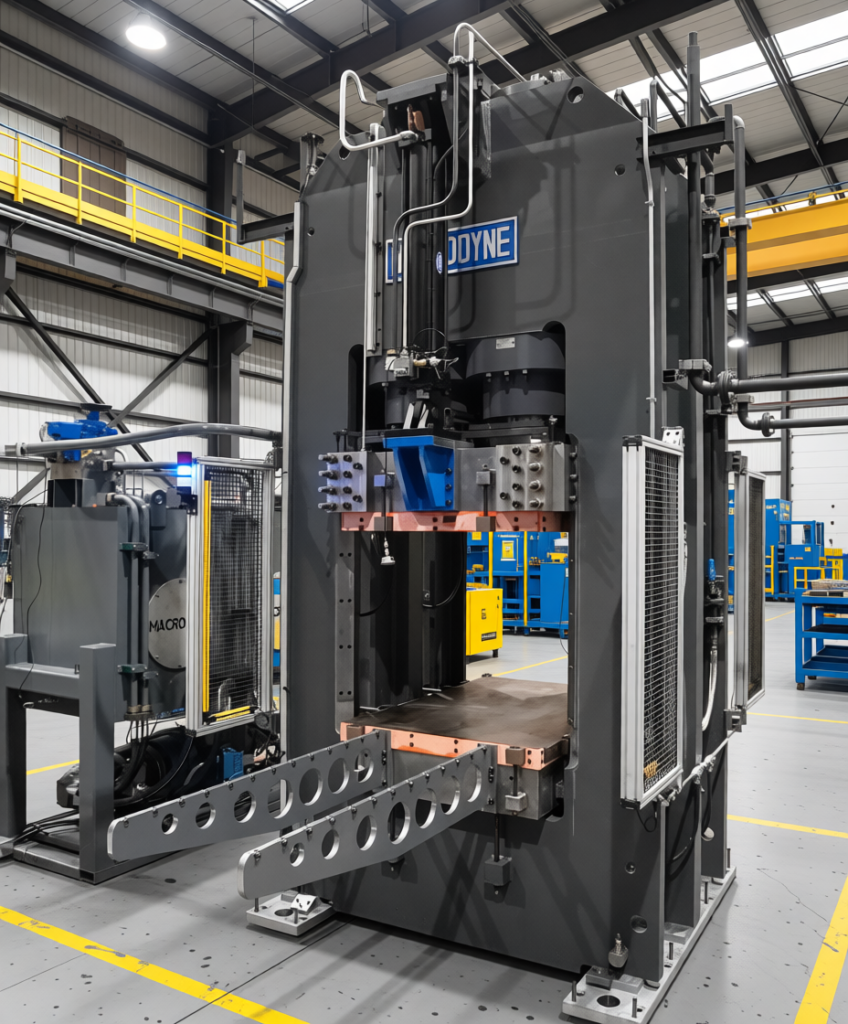
As UAV production scales, manufacturers are increasingly being evaluated not only on whether they can build a product, but whether they can build it repeatedly, reliably, and at volume.
That requires manufacturing systems capable of delivering:
- consistent cycle times
- repeatable quality
- traceable production data
- synchronized workflows
- stable throughput under pressure
Without those systems in place, scaling becomes difficult very quickly.
Labor dependency increases, while hidden bottlenecks emerge. Quality drift spreads and throughput fluctuates, so production schedules become unpredictable. Engineering teams – already overwhelmed – become trapped solving recurring manufacturing problems instead of improving the product itself.
Eventually, production instability starts impacting business performance.
This is why many drone manufacturers are beginning to rethink how their production lines are designed from the start. Instead of viewing automation as a future upgrade, it is increasingly being treated as a foundational part of scalable manufacturing strategy.
Particularly in defense applications, where long-term production readiness, domestic manufacturing capability and supply chain resilience are becoming strategic priorities, manufacturers are under growing pressure to build production environments that are stable and repeatable.
The next phase of drone manufacturing will be defined by which manufacturers can industrialize successfully. Because eventually, every drone program encounters the same reality: production pressure exposes everything.
It exposes weak process control. It exposes labor dependency. It exposes disconnected workflows, unstable throughput, and manufacturing systems that were never designed to scale.
The companies that succeed will not simply be the ones with the most innovative products. They will be the ones capable of manufacturing consistently under real-world production conditions.
In the years ahead, manufacturing discipline may become just as important as engineering innovation.
And increasingly, process control is what separates scalable production from production chaos.
Macrodyne works with manufacturers developing scalable forming, composite processing, and automated production solutions for demanding aerospace and defense applications.
To learn more about our capabilities in drone manufacturing and integrated automation, visit our drone Manufacturing page or contact our team directly.