

Radial compression systems for precise drive band seating, consistent OD control, and high-volume production
In large-caliber ammunition manufacturing, the drive band is not a secondary feature. It is a functional requirement that directly influences projectile stability, gas sealing, and in-bore behavior.
A drive band crimping press (also referred to as a radial band crimping press or hydraulic shell crimping system), is used to permanently seat a soft metal band, typically copper or brass, into a precision-machined groove on the projectile body.
This process is used across a range of large-caliber munitions, including 105mm, 120mm, and 155mm projectiles. Depending on the projectile design, band application methods may vary from traditional crimped or swaged bands to alternative approaches such as weld-on bands or weld build-up processes used in certain programs, including configurations like the M795 and M1128.
Macrodyne supports both ends of this spectrum. Whether the requirement is precision radial compression or integration with band welding and build-up processes, the focus remains the same: delivering consistent, repeatable results within a fully integrated production environment.
We’ve worked with automated projectile manufacturing systems where consistency, throughput, and
integration risk are critical.
Drive band installation is no longer a single-force, single-step operation. It is a programmable forming process that must adapt to different projectile designs, materials, and production requirements.
Macrodyne systems are designed with this flexibility in mind.
Adjustable tonnage profiles for different band materials and geometries
Multi-stage pressing capability for complex forming requirements
Precise control of band position and seating depth
Repeatable force application across high-volume production
Ability to install single or multiple driving bands
Simultaneous or sequential band forming without removing the projectile
Designed to accommodate varying projectile configurations
Fully automated systems capable of:
Loading projectiles from pallet or conveyor
Robotic placement of drive bands from magazine systems
In-line transfer between forming and inspection stages
*Compatible with a range of industrial robot platforms
Quick-change tooling for multiple calibers (e.g., 105mm, 120mm, 155mm)
Programmable recipes for different projectile types
Reduced downtime between production runs
Throughput requirements
Integration with upstream and downstream processes
Operates on industry-standard platforms:
Siemens
Allen-Bradley
Designed for seamless integration into:
Automated production lines
Inspection and gauging systems
Data tracking and traceability platforms


Drive band installation is a controlled forming process that requires uniform force, precise positioning, and repeatable execution. Radial crimping systems are designed to deliver that control by applying force evenly around the projectile, ensuring consistent results across high-volume production.
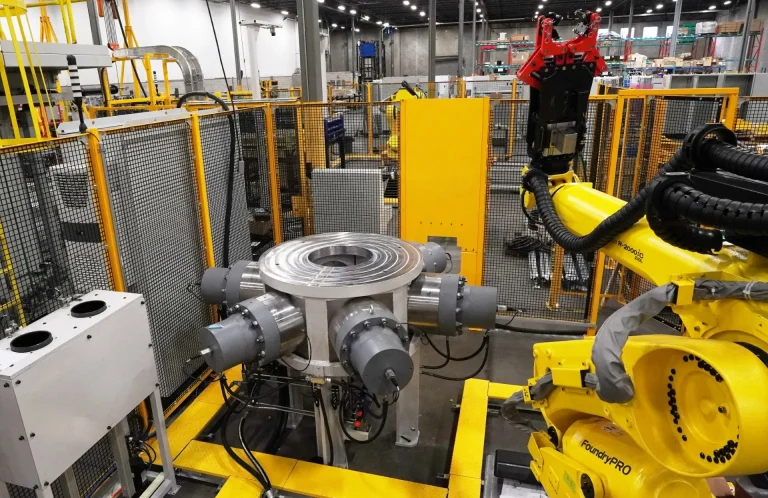
At the core of the system is a multi-ram radial press architecture, designed to apply uniform force around the full circumference of the projectile.
Multiple hydraulic cylinders (typically 6, 8, or 12) arranged circumferentially
Cylinders converge toward a central axis where the projectile is positioned
Simultaneous actuation ensures uniform radial force distribution
Fully programmable parameters including tonnage, dwell time, and stroke profile
This configuration is commonly referred to as a multi-ram radial press, drive band swaging machine, or radial band crimping press.
Positioning
The projectile is loaded with a loose drive band placed over the machined groove
The assembly is positioned against an adjustable hard stop to ensure precise band location
Loading can be performed:
Automatically, using robotic handling systems
Manually, depending on system configuration
All hydraulic rams actuate simultaneously to apply inward force
The band is compressed uniformly into the groove, preventing distortion or waviness
The process uses cold swaging, allowing the material to flow without heat
For certain applications, band heating can be incorporated where material behavior requires it.
For more complex requirements, the system supports programmable, multi-stage forming:
Controlled forming sequences with adjustable pressure profiles
Optional indexing or rotation of the projectile between forming stages
Re-alignment and secondary compression to ensure full seating and consistency
This approach improves uniformity, particularly for demanding tolerances or multi-band configurations.
Modern systems are fully CNC-controlled, with continuous monitoring of key forming parameters:
Radial Force Application: Ensures proper seating without overstressing the projectile
Outer Diameter (OD) Control: Maintains tight tolerances for weapon system compatibility
Cycle Repeatability: Delivers consistent results across high-volume production
All forming data is captured and stored as part of the process:
Force, position, and cycle time data recorded for each part
Integration with plant systems for traceability and quality tracking
Supports full production visibility across the manufacturing line
This enables manufacturers to tie forming data directly to individual projectiles, supporting full traceability across the production process.

If you’re comparing options for a drive band crimping press or hydraulic shell crimping system, we can help benchmark:
Radial crimping systems are engineered for more than forming force. They are designed to deliver consistency, integrate into complex production environments, and reduce risk across the process.
Uniform Radial Force Distribution: Eliminates uneven thickness and ensures consistent ballistic performance
Automation Integration: Supports automated drive band crimping for high-volume production
Flexible Integration with Custom Automation: Designed to integrate seamlessly into customer-specific automation environments, including existing or new production lines, with compatibility across a wide range of material handling and robotic systems
Reduced Risk to Projectile Integrity: Prevents distortion of the shell body during forming
Built for Defense Manufacturing Environments: Engineered for durability in forging, machining, and heavy industrial conditions
When evaluating a drive band crimping press for industrial use, engineers typically prioritize:

If you’re comparing options for a drive band crimping press or hydraulic shell crimping system, we can help benchmark:
Drive band crimping systems are used across a range of defense and aerospace applications where controlled radial force and repeatability are critical, including NATO standard munitions manufacturing. From ballistic engagement features to structural joining and precision component retention, these systems enable consistent forming without compromising part integrity. While often associated with large-caliber munitions, the same underlying process supports a much broader set of use cases across modern manufacturing environments.


A hydraulic shell crimping system is most effective when integrated into a complete production environment.
Typical system integration includes:
A turnkey approach improves reliability, reduces integration risk, and ensures consistent throughput across the entire line.

A drive band crimping press is used to permanently seat a rotating band onto a projectile by compressing it into a machined, often knurled or undercut groove near the base of the shell.
During firing, the band engages the rifling inside the barrel, causing the projectile to rotate as it travels down the barrel and exits with stabilized flight. The band also forms a seal to contain propellant gases and must remain securely attached under extreme acceleration.
A hydraulic crimping press uses controlled hydraulic pressure to actuate multiple cylinders. In a radial configuration, these cylinders apply uniform inward force from all directions, enabling precise cold swaging of the band into the groove.
This ensures consistent material flow, uniform deformation, and repeatable results across high-volume production.
The best drive band crimping press for industrial use depends on several factors, including production volume, projectile type, and level of automation required.
High-performance systems typically include:
Multi-ram radial compression for uniform force distribution
CNC-controlled forming parameters for repeatability
Integration with automated handling and inspection systems
In practice, the most effective solution is one that is engineered around the specific application, rather than a fixed, off-the-shelf configuration.
Safe operation of a drive band crimping press focuses on minimizing operator interaction with high-force forming processes.
Key considerations include:
Full guarding and interlock systems
Automated loading and unloading where possible
Proper setup and tooling procedures
Routine inspection of hydraulic, mechanical, and control systems
Modern systems are designed to reduce operator exposure to hazardous zones while maintaining consistent production output.
Heavy-duty drive band crimping presses are typically sourced from manufacturers with experience in high-force hydraulic systems and defense manufacturing applications.
Macrodyne supplies these systems through its North American and European operations, with manufacturing and support capabilities in Canada, the United States, and Germany.
Systems are engineered as complete solutions, including press, tooling, automation, and controls, to support long-term production requirements.
Leading manufacturers of industrial crimping equipment are those with proven expertise in hydraulic press design, radial compression technology, and full system integration.
Key differentiators include:
Ability to deliver custom-engineered systems
Experience with high-volume, mission-critical production
Integration of automation, controls, and traceability
Macrodyne is among those manufacturers, combining deep press engineering experience with the ability to deliver fully integrated, turnkey systems.
With manufacturing and support capabilities across Canada, the United States, and Germany, Macrodyne supports customers globally with solutions designed for long-term performance in demanding production environments.
Manufacturers that combine press engineering with full-system integration are best positioned to support modern production requirements, and to reduce risk across the entire production line.
A few common questions we hear when evaluating drive band crimping systems.
Band installation is only one part of the system. Force, throughput, handling, and integration all need to align.
Let’s walk through it with you.
Radial force requirements based on your band material
Cycle time and throughput targets
OD tolerances and inspection strategy
Automation and material flow
Let’s walk through it with you.

With Macrodyne’s high-force hydraulic presses, you can manufacture critical aircraft, defense, and space components with unmatched accuracy and repeatability. From fuselage panels and jet engine casings to landing gear and spacecraft structures, our advanced forming technologies ensure every part is built to perform.
Let Macrodyne deliver the precision and performance your aerospace manufacturing demands with industry-leading aerospace hydraulic presses and servo presses.
Macrodyne has designed and built many other presses not shown on the website.
80% of our presses are custom designed to meet the specific specification of each client.
Macrodyne has designed and built many other presses not shown on the website.
80% of our presses are custom designed to meet the specific specification of each client.