Scaling Defense Manufacturing: Why Manual Straightening is a Supply Chain Bottleneck
The U.S. defense industrial base is under pressure it hasn’t faced in decades, and a single human skill set stands between current production targets and scalable manufacturing performance.
From the Pentagon’s push toward expanded artillery production to accelerated naval modernization and rapid UAV deployment, industrial readiness is increasingly constrained by workforce limitations. Across heavy manufacturing, many operations still rely on a shrinking pool of veteran operators whose judgment, experience and intuition play a critical role in precision straightening and forming processes.
The problem isn’t that these workers lack skill. It’s that their expertise is difficult to replicate, transfer, or scale. A machinist who has spent decades understanding material behavior and corrective forming techniques carries valuable institutional knowledge. But when that knowledge retires, manufacturers face a difficult challenge: maintaining throughput, consistency and quality without decades of accumulated experience on the shop floor.
“Experienced operators are still one of the most valuable assets in heavy manufacturing,” says Timo Kolmann, DUNKES’ CEO. “The challenge is that experience cannot always be hired quickly, trained quickly, or scaled across multiple production lines. The opportunity with intelligent press systems is to help capture that judgment and turn it into a repeatable process.”
This reality is driving growing interest in AI-driven precision press solutions that reduce operator dependency while improving process repeatability. By integrating advanced measurement systems, digital twins, and intelligent correction algorithms, manufacturers can capture and apply process knowledge in a structured, repeatable way that supports both productivity and quality at scale.
“This is where AI becomes practical,” Kolmann adds. “Not as a buzzword, but as a way to support better decisions at the press and make complex correction processes more repeatable.”
Digitizing Tribal Knowledge: How AI Replaces the “Master’s Touch”
AI in precision metal forming is helping transform expertise that once depended on individual experience into a repeatable, scalable manufacturing process.
Sense
Modern straightening systems use laser-based and optical measurement technologies to capture detailed geometric data from incoming components. Internal and external measurements create a comprehensive digital representation of the part, identifying dimensional variation, straightness deviations, and other geometric conditions before corrective force is applied.
Calculate
The AI layer uses digital twin technology and historical correction data to predict how a component will respond to straightening forces. The system continuously analyzes measured conditions, previous correction cycles, and material behavior to determine optimal force levels while minimizing unnecessary iterations.
Execute
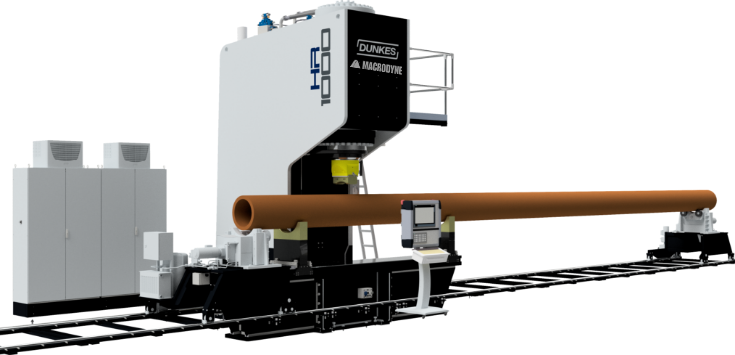
An automated straightening platform then applies corrective force within a closed-loop manufacturing process. Measurement, analysis, force application, and verification become integrated into a continuous workflow.
Cross-Sector Vulnerabilities: Beyond Artillery Production
Aerospace Structures
Aerospace manufacturers face similar challenges when producing mission-critical structural components where dimensional accuracy and repeatability are essential.
UAV Structures
The rapidly expanding UAV sector faces a strict tolerance crisis. Machining or compression-molding high-performance alloys and composites frequently induces severe internal stresses. Part warping is common, yet flight-critical components allow zero margin for error. Relying on an operator to manually “feel” whether a titanium longeron has been perfectly trued introduces unacceptable micro-deviations.
Naval Shipbuilding
In shipyard infrastructure, heavy hydraulic presses are the backbone of assembly. Forming and straightening massive naval hull sections, bulkheads, and deck structures requires managing thick, high-strength steels that exhibit unpredictable residual stresses after welding.
Labor Market Disruption and Policy Readiness in the AI Era
The most significant workforce shift isn’t the loss of skilled workers. It’s the emergence of an entirely new role: the systems technician who manages AI rather than replaces it.
The fastest path to closing the skills gap is reskilling. Training an experienced press operator to interpret AI-generated correction parameters takes weeks, not years. Finding and developing a new master straightener takes decades. Tech coalitions are already moving on this, recognizing that adapting the existing workforce to AI-augmented environments is the most scalable response to blue-collar labor shortages across industries.
In practice, the manual operator role, once defined by tactile judgment and hard-won intuition, is giving way to a systems technician profile centered on monitoring, calibration, and exception handling.
Workers don’t disappear from the equation; their leverage simply multiplies. One trained technician managing an AI-assisted press line can now oversee output volumes that previously required an entire team of specialists.
Defense supply chain automation introduces a layer of complexity beyond standard manufacturing: compliance. Integrating AI into defense-contracted environments requires strict alignment with program documentation, secure data logging, and supplier qualification frameworks.
Policy readiness isn’t optional; it’s a prerequisite. Manufacturers who treat AI adoption as a technical upgrade without addressing the contractual, ITAR, and regulatory dimensions face immediate friction at the Tier-One qualification stage.
What You Need to Know About AI-Driven Straightening
The skilled labor deficit isn’t a staffing problem you can recruit your way out of. It’s a permanent structural shift that demands a fundamental rethink of how precision press solutions are deployed on the production floor.
The convergence of an aging workforce, a shrinking skilled trades pipeline, and surging defense production volumes have created a gap that no hiring campaign closes. Industry analysts confirm the dynamic is accelerating, not reversing. Tier-One primes that treat this as a temporary disruption are already falling behind on delivery commitments.
Here’s what the evidence shows:
- The labor shortage is structural. Demographic trends and training timelines mean the deficit compounds year over year. Waiting it out isn’t a strategy.
- AI-driven straightening codifies artisan skill. The intuitive judgment of a veteran press operator doesn’t retire with them — it becomes scalable institutional IP embedded in the system.
- Machine vision is non-negotiable at scale. Meeting surging multi-sector defense contracts with consistent dimensional accuracy is physically impossible through manual inspection alone.
- Modernization is a Tier-One prerequisite. Defense primes are actively auditing supplier capabilities. A press floor that can’t demonstrate adaptive, data-driven quality control is a supply chain liability.
The manufacturers who act now are not only solving today’s bottleneck. They’re building the production infrastructure that qualifies them for tomorrow’s contracts.
Future-Proofing Your Production Floor
The skilled labor deficit demands a permanent engineering response, not a staffing workaround. Tier-one primes that are winning on delivery schedules and first-pass yield rates aren’t doing it by waiting for the talent pipeline to recover. They’re embedding precision and process knowledge directly into their equipment.
The most productive first step is an honest audit of where straightening bottlenecks are costing you yield, cycle time, or inspector hours. A Macrodyne-DUNKES applications specialist can map your current process gaps against the capabilities of AI-driven straightening and define what a purpose-built solution looks like for your production environment.
If your floor is still trading skilled-operator intuition for dimensional conformance, it’s time to change that equation. Contact us to schedule a technical consultation and start converting your straightening bottlenecks into a competitive advantage.