

An Introduction
Manufacturers choose compression molding when they need repeatable composite, polymer, or rubber parts; the ability to form relatively large components; or opportunities to consolidate several pieces into one molded part. The process is used for medium- to high-volume production, as well as lower-volume, high-value composite applications where part performance is critical.
A measured material charge is placed in matched-metal tooling and compressed under a controlled combination of force, temperature, position, speed, and time. When tooling and process controls are properly engineered, compression molding can produce highly repeatable, dimensionally accurate parts and can provide a competitive per-part cost, particularly at medium to high production volumes.
Many fiber-reinforced composite materials achieve excellent strength-to-weight ratios and can replace metal in appropriate applications. Depending on the material and tooling, additional benefits can include corrosion resistance, electrical insulation, Class A surface finishes, lightweighting, and reduced assembly through part consolidation. Applications include seals, gaskets, electrical housings, industrial components, automotive body and EV battery structures, and aerospace parts.
Modern compression molding applications increasingly include carbon fiber and advanced glass fiber composites used in lightweight transportation structures, EV battery enclosures, aerospace components, and hydrogen storage systems. These applications often require precise control of temperature, pressure, platen parallelism, and process repeatability, making press design a critical factor in achieving consistent part quality and performance.
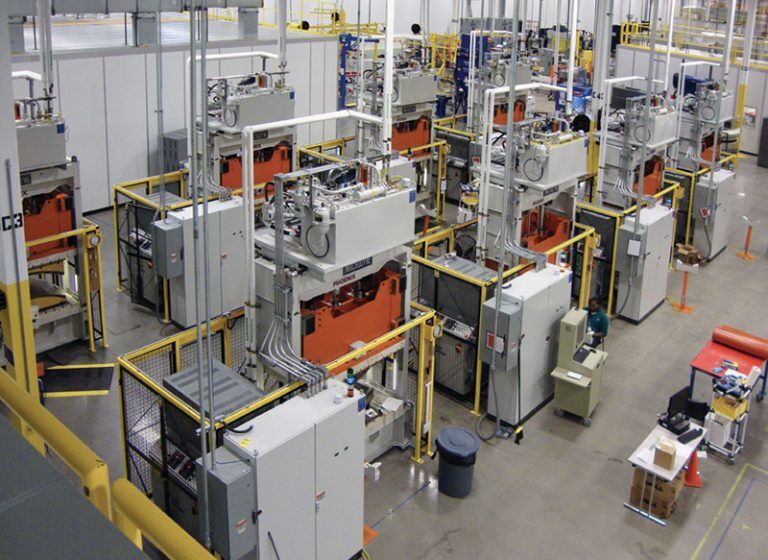

Common Material Families
Thermoset molding compounds include sheet molding compound (SMC), bulk molding compound (BMC), and thick molding compound (TMC). Common resin systems include epoxy, phenolic, melamine, urea-formaldehyde, polyester, vinyl ester, polyurethane, cyanate ester, bismaleimide (BMI), and selected silicone systems.
Thermoplastics range from commodity polymers such as polypropylene (PP) and high-density polyethylene (HDPE), to engineering polymers such as nylon (PA), and high-performance materials such as PEEK, PEKK, PPS, PEI, and other PAEK-family polymers. Reinforcements can include glass, aramid, and multiple grades of carbon fiber.
Material Selection and Process Parameters
Material selection, fiber architecture, charge placement, part shape, and wall thickness all influence preheating, molding temperature, cavity pressure, holding time, cooling rate, venting, and blank-holder requirements. These variables should be evaluated together rather than treated as independent settings.
Both thermosets and thermoplastics have a glass transition temperature (Tg), although their behavior differs significantly. Thermoplastics soften when heated above their processing temperatures and can be remelted. Cured thermosets retain their crosslinked structure and cannot be remelted. Semi-crystalline thermoplastics also have a melting temperature (Tm), which is often more relevant during processing.

Higher fiber loading often requires higher molding pressure because the material becomes less flowable. The exact requirement also depends on resin viscosity, fiber length and orientation, charge placement, flow distance, processing temperature, part geometry, and tool design.
Charge weight, coverage, and orientation influence flow paths, fiber orientation, knit lines, flash, and part-to-part consistency. Greater charge coverage can reduce required flow distance, but placement should be confirmed through process development and, where appropriate, mold-flow, cure, or structural simulation.
Accurate control of position, speed, force, and temperature improves repeatability, cure consistency, dimensional stability, and tooling protection while helping reduce voids, flash, warpage, and scrap.
Preliminary Press Tonnage
Projected molding area (in²) × estimated cavity pressure (psi) ÷ 2,000 = preliminary press tonnage (tons)
This is a preliminary sizing guideline, not a final design calculation. Required cavity pressure, projected area, flash-land design, material flow, load distribution, and tool construction can all change the result. Final tonnage should be verified during tooling and process design.
Modern press controls typically allow multiple programmable position, velocity, and pressure stages throughout the molding cycle, together with recipe management and process-data capture. The required control strategy should be defined around the material, tool, part geometry, and production objective.
The Compression Molding Process
Compression molding commonly uses a matched-metal mold with a cavity and core machined from steel or aluminum. Depending on the material system, heat can be delivered through the tooling, the press platens, or both; thermoplastic applications may also require controlled cooling.
At a high level, the process moves from material preparation and charge placement through controlled closure, consolidation or cure, demolding, trimming, and inspection. The exact sequence and thermal cycle depend on whether the material is a thermoset, thermoplastic, elastomer, or rubber.
Thermoset Process
- Install the matched-metal tool and bring it to the specified temperature. Heating can be integrated into the tooling, supplied through heated platens, or combined.
- Place the measured charge in the mold. Charge weight, coverage, and orientation are selected to support the intended flow path and fiber distribution; the charge may be preformed or preheated.
- Close the press using a programmed position, speed, and pressure profile. As the mold closes, the material flows through the cavity and is consolidated.
- Hold the tool closed under the specified temperature and pressure until the crosslinking reaction reaches the required state of cure.
- Release pressure, open the tool, remove the part, and complete any required deflashing, trimming, and inspection. Control of material temperature and residence time helps avoid premature cure, incomplete cure, warpage, and other defects.

The values below are representative starting ranges for some thermoset applications. Final settings depend on the resin system, reinforcement, geometry, tool, and required part performance:
Clamp Tonnage | 1000 – 2500 psi on the molded surface area of the part |
Clamp Close Speed | 500 – 1200 inches per minute |
Pressing Speed | 0 – 35 inches per minute |
Temperature | 290 to 400°F |
Thermoplastic Process
Thermoplastics are heated above their processing temperature, formed and consolidated under pressure, and then cooled below the demolding temperature while the tool remains controlled. Unlike thermosets, they do not cure or crosslink and can be reheated, although repeated processing can degrade the polymer or shorten reinforcing fibers.
Key Thermoplastic Considerations
Closure speed must be fast enough to limit premature cooling while remaining controlled enough to avoid trapped air, fiber wash, poor material distribution, and tooling shock. Preheating and accurate charge placement can improve flow and reduce flash.
Clamp force should match the projected molding area, material system, pressure profile, and tool design. Excess capacity does not replace accurate control, and insufficient force can contribute to flash, incomplete consolidation, or dimensional variation.
Cycle time depends on material grade, wall thickness, charge temperature, tool temperature, heating and cooling capacity, and demolding requirements. Programmable motion can improve productivity, but closure speed should be optimized for material flow and laminate quality rather than treated as a maximum-speed target.
Mold and demolding temperatures vary significantly by thermoplastic family and the required cooling profile. High-performance polymers such as PEEK, PEKK, PPS, and PEI can require substantially higher tooling and heating capability than commodity or engineering thermoplastics.
Commonly Used Thermosets
Epoxy, phenolic and unsaturated polyester resins, unsaturated polyester, vinyl ester, polyurethane and anaerobic adhesives are all examples of commonly used thermosets in the compression molding process.
Below, the two photos highlight the difference between preformed epoxy material and phenolic material:


Sheet molding compound (SMC)
Sheet molding compound (SMC) is a fiber reinforced thermoset material (a combination of polymer resin, inert fillers, fibers, catalysts, pigments, stabilizers, release agents and thickeners) often used for larger parts that require greater mechanical strength. Glass reinforcement is between 10 and 60 percent and fiber length is slightly longer than those of bulk molding compound (BMC), between ½-inch and 1-inch.
The manufacturing process of SMCs is a continuous in-line process where the material is sheathed both top and bottom with a polyethylene or nylon plastic film to prevent auto-adhesion. The paste is spread uniformly onto the bottom film, the chopped fibers are added on the paste in a random fashion and the top film is introduced to the process, rolled into a pre-determined thickness and left to mature for 48 hours.
SMC satisfies applications that produce appearance critical parts that have a Class A finish, but it is also ideal for painting and structural applications that require strength and stiffness, but not an appearance critical aesthetic.
Bulk molding compound (BMC)
Bulk molding compound (BMC) is a thermoset plastic resin that is similar to SMC but the way in which the fibers and the resin are combined differs. It is still a blend of inert fillers, fiber reinforcement, catalysts, stabilizers, and pigments, but they form a viscous putty. The material is highly reinforced using short glass fibers, with a glass reinforcement measure of 10 to 30 percent, with lengths between 1/32-inch and ½-inch.
BMCs will achieve close dimensional control, flame and track resistance, electrical insulation, corrosion and stain resistance, in addition to heightened mechanical properties, minimized shrink capacity, and color stability which make it ideal for applications requiring precision in detail, dimension and performance. It can also tolerate powder coating and water-based paint.


Thermosets, in general, offer excellent flame, smoke and toxicity characteristics. A great example is cyanate ester which boasts extremely low out gassing attributes. They also promise low density, corrosion resistance and dielectric characteristics. They are cost-effective and offer design flexibility that many projects yearn for.
Composite materials
Composites, such as laminated plastics, are also thermosets that are utilized in the compression molding process. Laminated plastics are a special form of polymer-matrix composite that is comprised of layers of fiber reinforced materials that are impregnated with thermosetting resins (typically phenolics), bonded together using heat and pressure. Once the material is impregnated and dried, it is cut into sheets, stacked together, and pressed using high pressure and specified temperatures (270° to 350°F). This results in a laminated composite that can range from hard materials to softer plasticized grades, depending on the application.
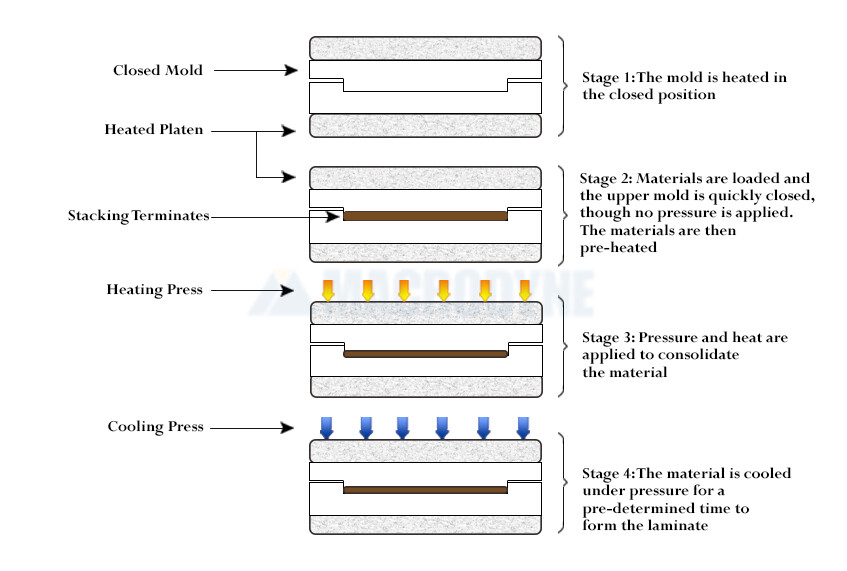
Laminated thermosets offer high mechanical strength, dimensional stability, rigidity, a high strength-to-weight ratio, as well as good electrical, moisture and temperature resistance. During the production process of these multilayer materials, it is important that fibers are thoroughly wetted with resin, with the excess resin removed.
Laminate needs to be consolidated to thickness and all trapped air, moisture and solvent vented to avoid porosity in the material. Curing time is imperative to ensure the material is neither over-, nor under-cured.
Applications for these laminated composite materials include switchboard panels and terminal boards, starter/generator/television insulation, gaskets, washers, gears, or any other product where high feeding and cutting speeds are present.
Cured laminates, also referred to as high-pressure laminates, are produced in over 70 standard grades in compliance with National Electrical Manufacturers Association (NEMA) specifications. The same base materials can be found in molded-laminates and molded-macerated parts where mold costs are justified by production quantities and where machining from flat laminates is uneconomical.
Thermoplastics in the compression molding process
Just like its thermoset counterpart, thermoplastics offer a great alternative to metal parts where corrosion is a concern. It can stand up to harsh, even toxic environments, and offer a much greater finish for the associated costs when compared to alternative materials.
There are two categories of thermoplastic polymers: amorphous and semi-crystalline. Amorphous thermoplastics form no crystalline structure. Above the glass transition temperature (Tg) the polymer modules are solids and enough energy exists to promote movement of the molecules in relation to each other, enabling molding to take place at these temperatures.
Poly-ether-imide (PEI) is an example of an amorphous thermoplastic polymer. Its Tg is 423°F and its process temperature ranges between 575° and 625°F. Nylons can be amorphous or semi-crystalline. Unlike semi-crystalline polymers, amorphous thermoplastic polymers can be molded at temperatures closer to their Tg.
Semi-crystalline polymers have areas where the polymer packs closely together and forms a crystal lattice, as well as areas where it is amorphous. The degree of crystallinity in a specific part will depend on the polymer type and the rate of cooling. Poly-ether-ether-ketone (PEEK), poly-ether-ketone-ketone (PEKK) and Poly-phenylene-sulfide (PPS) are all semi-crystalline thermoplastic polymers.
PEEK: Tg – 290°F, process temperature range – 715°F to 740°F.
PEKK: Tg – 312°F, process temperature – 645°F to 690°F.
PPS: Tg – 192°F, process temperature – 550°F to 620°F.
Further to their categorical classification, thermoplastics exist in three material forms. The first are the fabric prepregs that employ a common carbon or glass fiber woven material with a thermoplastic resin incorporated into the fabric.
They are also referred to as semi-pregs because the resin is mostly on the surface until high temperatures are introduced to initiate the impregnation process. These conformable materials are used primarily on large continuous structures.
The second material form refers to reinforced thermoplastic laminates (RTL), multi-ply oriented laminates that vary in terms of the materials used and the number of layers they form, as well as width and length and are classified as such, on the basis of grade, class, resin and orientation.
RTLs have undergone the high-pressure, high-temperature thermoforming process to achieve optimal fiber bundle impregnation of the thermoplastic resin. Given the ability for RTLs to be quickly heated and processed, it is utilized in short cycle thermoforming processes.
The third material form in which thermoplastics exist is a thermoplastic unitape that ranges in width, including chopped molding compound grade, or one-eighth-inch slit tape. The advantage of this form is efficiency when using automated tape laying and fiber placement equipment and the wide variety of automation solutions that exist.
When compared to thermosets, thermoplastics come with a higher initial raw material cost over thermosets and increased tooling costs due to the higher processing temperatures required. Unlike thermosets, which require cold storage and cold transportation, there is no chemical reaction in thermoplastics so they can be stored at room temperature with no degradation of its properties.
Other advantages of thermoplastics include high strength, shrink-resistance, and flexibility. Thermoplastics are applicable for use in low-stress applications or high-stress mechanical parts. The weight to performance ratio of thermoplastics, as well as its versatility and recyclability make it ideal for high volume, precision applications. Unlike thermosets, its curing process is reversible, as no chemical bonding takes place. When recycled and remolded, its physical properties are not compromised.
The primary disadvantage of using thermoplastics instead of materials such as metal, is their relatively low melting point. Certain types of low-quality thermoplastics can melt when they are exposed to the sun for extended periods. Some thermoplastics can also have poor resistance to organic solvents and hydrocarbons.
Another disadvantage of thermoplastics is that they are susceptible to creep, which occurs when the material stretches and weakens under exposure to long-term stress loads. The susceptibility to creep is further exacerbated by the lower melting temperature of the material. Other types of thermoplastics, such as composites, can fracture instead of becoming deformed under high-stress conditions.
Commonly Used Thermoplastics
Commonly utilized thermoplastics include polyethylene (PE), polyvinyl chloride (PVC), and polystyrene (PS), as well as acrylics, fluoropolymers, polyesters, polyimides, and nylons. They are used in a number of applications from plastic containers to bottles, plastic bags, ropes, belts, components for aerospace applications, medical devices, and many more.
PEEK is a high performance, semi-crystalline, organic thermoplastic polymer that is used in a number of engineering applications. It is colorless and organic and part of the polyaryletherketone (PAEK) family. As an advanced biomaterial, PEEK exhibits excellent mechanical and thermal properties, resistance to creep at high temperatures, low flammability, and resistant properties.
PEEK’s mechanical and chemical resistance properties are retained in high temperatures and organic and aqueous environments, making it ideal for applications such as bearings, piston parts, pumps, compressor plate valves, electrical cable insulation, used in automotive, aerospace, chemical processing and many other applications. It is also used in the production of medical devices and implants.
Due to the fact that PEEK melts at a relatively high temperature, it results in parts that are thermostable and electrically and thermally insulated. Like other semi-crystalline materials, it is subject to dimensional changes and shrinkage when it crystalizes, though it can be easily accounted for in the process.
Another material in the PAEK family is PEKK. Also considered a high-performance semi-crystalline thermoplastic polymer, it too provides strength, heat and chemical resistance and low flammability, ideal for demanding applications. Though PEKK is similar to PEEK, the former replaces one of the flexible ether linkages in the material composition making it a more rigid ketone offering.
PEI is an amorphous thermoplastic with high mechanical, thermal and electrical properties, strength, and rigidity. When reinforced with glass fiber, it provides greater tensile strength, rigidity, and improved dimensional stability.
As a plastic, it possesses similar characteristics to polyarylsulphones (PSU, PPSU), though it is similar in benefits. It offers resistance to creep over a wide temperature range, hydrolysis, and dimensional stability at a high permanent operating temperature, as well as electrical insulation, resistance to radiation, chemicals like chlorine and other caustic cleaning agents.
High-density polyethylene (HDPE) is another commonly used thermoplastic. It is derived from the natural gas ethane, which, when heated to 1500°F, its molecules break apart. One of the separated molecules is the gas ethylene which becomes a resin in the polymerization process and produce polyethylene. Polyethylene is used to make a number of different types of plastics including low-density polyethylene (LDPE) and polyethylene terephthalate (PET or PETE).
HDPE’s properties make it resistant to many solvents, impact and weather resistant, it has a high density-to-strength ratio, meaning it is lightweight and strong, and it is ideal for recycling and reuse which is why it is frequently the material of choice for bottles or bags, as well as toys, pipes, lumber and fireworks.
Direct long fiber thermoplastic (DLFT) are essentially long fiber thermoplastics (LFT) in direct compounded form. It is a type of composite material where thermoplastic polymers are used, mixed with fiber reinforcements and other additives, molded, and cured under pressure to produce a strong material that offers geometric flexibility and faster cycle times.
In the case of DLFT, size does matter. It is ideal for large automotive parts, as the smallest parts should weigh at least 2 pounds, though 4 pounds or greater is preferred. It can be used where decreased weight and increased performance are desired material properties. It can be used to produce decorative surfaces with textures requiring minimal finishing.
While DFLT can be recycled and reused, without compromising its performance. Disadvantages include higher tooling costs limited heat resistance, limited true class A capability and weaker dimensional stability when compared to thermosets.
As indicated, there are countless resin and fiber combinations that result in a diversity of materials and material properties that can be utilized in the compression molding process, which is why it is important to leverage the knowledge and support of experts who can lead you through the process and material decisions to ensure your application and output performs optimally and produces desired results.
Advantages and disadvantages of compression molding
Compression molding produces composite parts of varying complexities that are comparable to those manufactured from metal. They offer the same strength and mechanical properties but outperform metals in their weight-to-performance ratio, anti-corrosive and electrically insulative properties, and require less post-fabrication machining to meet geometric specifications.
One of the greatest advantages of the compression molding process is the ease at which ribs, and other inserts can be incorporated at the time of forming which reduces or completely eliminates the need for secondary processes. With one process, it can replace several assembled parts with one complex compression molded part.
The ability to incorporate secondary processes reduces the need for labor and parts inventory and minimizes material scrap and inspection times. Another benefit is the low tooling cost and the need for less costly capital equipment, as well as the fact that it is adaptable to automation. All of these things result in cost savings without compromising performance, quality, and output.
Shortfalls of compression molding are that the process is not ideal for very intricate parts or parts containing undercuts, side draws, or small holes, as it runs the risk of producing small distortions or breaks as a result of the process flow and pressure. From a process perspective, compression molding rivals injection molding in most ways, except in terms of cycle times which are longer on account of heating and cooling processes, which are paramount to part performance and quality when using thermosets and thermoplastics in the compression molding process.
Visit our Compression Molding page to learn more about custom Compression Molding Presses.
Contact us about your hydraulic press needs.

