Tonnage gets a lot of credit in metal forming. Sometimes more than it deserves.
A press can have more than enough force and still produce a part that cracks, wrinkles or thins beyond tolerance. When that happens, adding tonnage is rarely the clever answer. The real constraint may be how the material flows as the ram and cushion move through the draw.
Consider a stainless steel kitchen sink. As the punch pulls the blank into the die, the flange must feed inward under controlled restraint. Too much restraint can increase tensile stress and promote tearing or local thinning. Too little can allow the flange to buckle and wrinkle. Tool geometry, material properties, lubrication, blank-holder force and press motion all influence whether the process stays inside a workable window.
Most press technologies give engineers some control over that window.
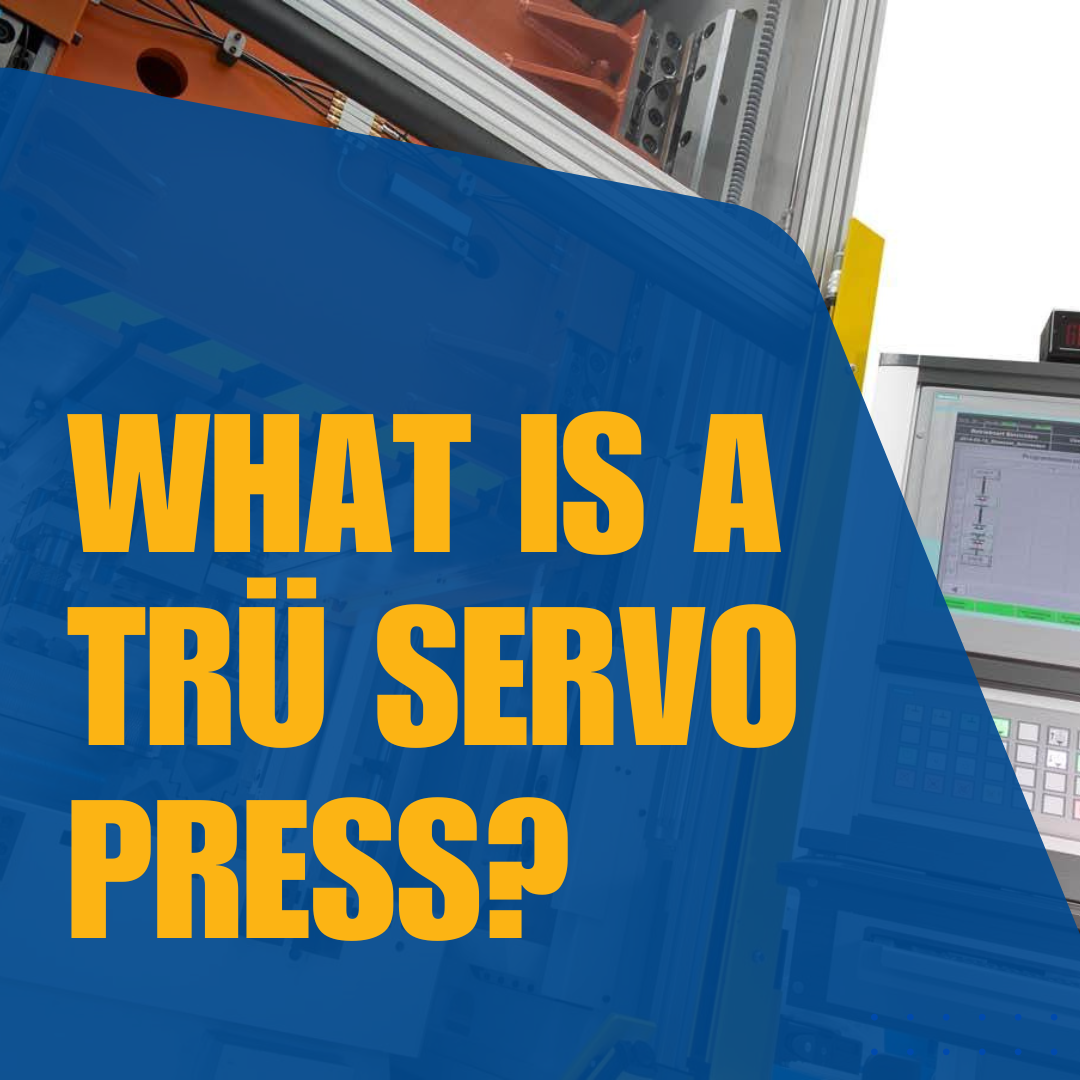
Macrodyne’s TRü Servo expands the available motion strategies by combining a direct electromechanical drive with programmable slide and cushion movement. Its proprietary Deepest Draw™ technology can introduce controlled reversals or pulsations during forming, depending on the material and failure mechanism.
That does not make TRü Servo the right press for every job. A very expensive answer to a straightforward forming problem is still a very expensive answer. But when conventional press motion (not available force), has become the limiting variable, TRü Servo gives engineers another way forward.
What a TRü Servo Press Actually is
The term “servo press” is pretty broad. A servo-mechanical press uses a servo motor in place of a conventional flywheel drive, but the crank, eccentric or linkage still determines how motor rotation becomes slide movement. A servo-hydraulic press uses servo-controlled pumps or motors to manage oil flow through a hydraulic circuit. Both can provide valuable control, but their drive architectures remain fundamentally different.
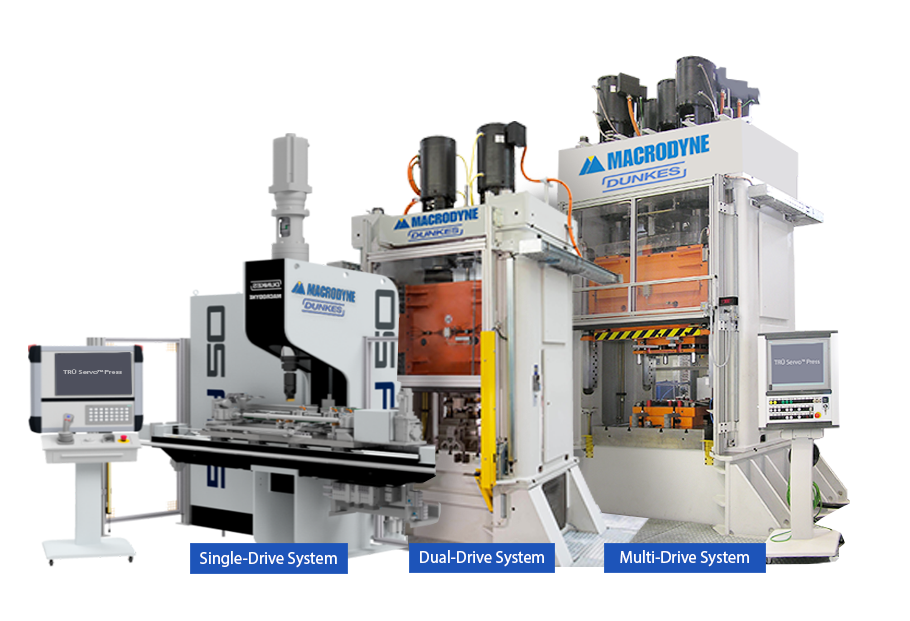
TRü Servo is a direct-drive electromechanical press platform. High-torque servo motors turn precision planetary roller screws, converting rotary motion directly into linear slide movement. There’s no hydraulic cylinder driving the main slide and no hydraulic oil in that force path.
Jeffrey Walsh, Macrodyne’s Director of Business Development, first encountered the technology while visiting DUNKES, Macrodyne’s German operation where servo spindle presses have been developed and applied for more than 15 years. He remembers noticing a press that looked familiar until he took a closer look. “It looked like a hydraulic press, but the cylinders were actually large servo-driven screw units,” he recalls.
That visual similarity is useful because TRü Servo can provide linear motion and force across the working stroke. The method used to produce and control that motion is different.
This distinction matters when equipment is being evaluated. Asking whether a press is servo-controlled is not enough. The more useful question is how the drive converts motor command into slide motion, and what that architecture allows the process to do.
How the TRÜ Drive System Moves the Slide
TRü Servo is the press platform. TRÜ Drive is the electromechanical drive system within it. Deepest Draw™ is the forming technology that uses the drive’s programmable motion for difficult drawing applications.
Walsh describes the drive system as “pretty straightforward.” A large planetary nut is connected to the press slide, while a high-torque servo motor turns the precision-ground screw passing through it. “When the servo motor turns one way or the other, the slide moves up and down,” he explains.
At the control level, the press controller sends a command to the servo drive. The motor rotates the screw mechanism, and that rotation produces a defined linear movement at the slide. Feedback devices allow the control system to regulate position, speed and force against the programmed profile.
The direct force path, high structural rigidity and relatively low rotating inertia support precise positioning and rapid changes in direction. Actual force and speed remain machine-specific, so the useful comparison is not that TRü Servo is always faster or stronger than another press. It’s that the slide motion is not constrained by a crank curve and does not depend on controlling hydraulic flow.
TRü Servo can also provide full rated force at different positions in the stroke, subject to the machine’s engineered force-speed envelope. In practical terms, Walsh says, “you can have full force at any position for as long as you want throughout the stroke.” That capability can matter when significant forming work occurs over a longer distance, as it can in deep drawing, extrusion and some forging operations. It’s less important when the process only needs a short, repeatable hit near bottom dead center.
Why Conventional Deep Drawing Reaches a Limit
Deep drawing forms a flat sheet blank into a hollow shape by pulling material into a die cavity. For a cylindrical part, drawing ratio is commonly expressed as blank diameter divided by punch diameter. As that ratio increases, the process demands more controlled material flow and the risk of failure rises.
The punch-radius area is often critical. The material is pulled over the radius while tensile stress increases and sheet thickness may decrease. Meanwhile, the flange is subjected to compressive stress as its circumference becomes smaller. Blank-holder action must control the resulting tendency to wrinkle without restraining the sheet so strongly that it tears.
The available process window is influenced by several connected factors:
- Material grade, thickness, anisotropy and work-hardening behaviour
- Punch and die geometry, radii, clearances and surface condition
- Lubrication and changing friction at the tool-sheet interface
- Blank-holder or cushion force and how it changes during the draw
- Ram speed, position, dwell and motion profile
This is why a larger press may not solve a failed draw. If the installed machine already supplies the required force, more tonnage can leave the underlying strain distribution unchanged. A thicker blank may protect the thinnest area, but it also adds material cost across the entire part. Another redraw stage may work, but it adds tooling and handling.
Walsh often returns to the stainless steel kitchen sink because it makes the issue easy to picture. It’s “a good example of where TRü Servo shines,” he says, but the real target is not the sink itself. It’s the familiar class of parts that fail near a practical drawing-ratio limit, even after the basic tooling, lubrication and material decisions have been addressed.
How Deepest Draw™ Changes the Motion Strategy
In a conventional draw, the ram generally advances in one direction while the blank holder or cushion controls material entering the die. Deepest Draw™ adds motion options that can change strain development and friction conditions during the stroke. Two strategies are central to the technology.
Bidirectional deep drawing, or BDD, is intended for materials with a relatively steep flow curve, including stainless steel and some high-strength steels. The programmed motion introduces a controlled reverse movement that changes the strain path before drawing continues. Under suitable conditions, this can work-harden and strengthen a critical area before it reaches the point where conventional drawing would produce a crack.
Cushion-ram pulsation, or CRP, is used with materials that have a flatter flow curve, including mild steel and aluminum. The ram and cushion follow coordinated profiles that repeatedly separate the drawing action from wrinkle control. During one part of the cycle, material is allowed to feed. During another, the cushion closes the gap to control the flange. Published research describes CRP at frequencies from 10 to 50 Hz, while Macrodyne’s approved technical material documents synchronized movement at 15 Hz with a 0.5 mm stroke.
The critical point is coordination. The upper slide and cushion are not simply moving back and forth independently. Each axis follows an electronically synchronized profile so their relative position and movement can be controlled throughout the forming sequence.
As Walsh explains it, the press may advance into the material, stop, reverse slightly and advance again. The motion happens quickly enough that the useful result is not a visibly interrupted process. It’s a different interaction among the sheet, tooling and blank holder.
The exact mechanism and benefit depend on the material. BDD uses a changed strain path and controlled work hardening. CRP changes the timing of drawing and restraint and can alter frictional conditions. Neither method compensates for poor tooling, unsuitable material or inadequate lubrication. They give process engineers additional variables to work with after those fundamentals are sound.
Where TRü Servo May Fit
Deep drawing is where TRü Servo makes its strongest case.
The process can directly benefit from programmable reversals, pulsation and coordinated cushion motion, particularly when a part is already pushing the practical limits of conventional drawing.
Potential applications include automotive housings, trays and structural cups; aerospace and defense casings or thin-walled components; and household products such as stainless steel sinks. The common thread is not the industry. It is a difficult draw in which material flow, wall thickness or part quality cannot be managed reliably through tooling and conventional press motion alone.

The same drive platform can support blanking, coining, forging, extrusion and compression molding, but the justification changes with the process. In blanking and coining, engineers may use programmable motion to control the approach, breakthrough and return. In forging or extrusion, the advantage may be full force over a longer working stroke. For compression molding, cleanroom production or laboratory work, the absence of hydraulic oil may matter more than Deepest Draw™.
The programmability also makes TRü Servo an interesting process-development platform. Engineers can test changes to position, speed, dwell, force and oscillation without being permanently tied to one mechanical motion curve. It does not rescue poor tooling (and no serious press builder should pretend otherwise), but it gives development teams more variables to work with during trials and more flexibility when the press is later retooled.
Still, an impressive application list is not an engineering assessment. Part geometry, material behavior, required force, production rate, tooling envelope and the complete manufacturing sequence determine whether TRü Servo is a practical fit. The technology earns its premium when that added control solves a real process constraint, not simply because the motion profile looks good on a screen.
When TRü Servo is Worth the Premium
Walsh is direct about the limits of the technology. “There’s no one press that serves all applications,” he says. A mechanical press may remain the right choice for straightforward high-speed stamping. A hydraulic press may be more practical when very high force, long dwell or a conventional linear forming profile governs the job. A mature process that already meets its rate, quality and scrap targets may gain little from additional motion freedom.
TRü Servo becomes more relevant when the current process has a measurable constraint tied to motion or force position. Strong signals include cracking or excessive thinning, a part at its practical drawing-ratio limit, several redraw operations, the need for synchronized slide-and-cushion movement, force required away from bottom dead center, an oil-sensitive environment or an active development program that needs programmable profiles.
The possibility of eliminating a redraw operation or tooling set can justify investigation, but it should not be built into a business case until the part has been tested. The same applies to claims about scrap, material thickness, energy use or cycle time.
Walsh compares the decision to buying a car. A $200,000 car and a $60,000 car can both get to the grocery store. The premium only makes sense when the additional capability serves the job. “Why would you spend more if you’re not going to get an advantage from it?” he asks. That is the right standard for TRü Servo. It’s not better simply because it offers more programmable capability. It’s better for a particular application when that capability solves a documented problem or creates a production option the simpler machine cannot provide.
What to Send for an Application Review
The first discussion should begin with the part rather than a preferred press type. Walsh starts by asking what the process and parts look like, where the current application fails and whether the job needs carefully tuned forming profiles or simply speed and force. For a useful initial review, provide the information available in these areas:
- Part drawing or representative geometry, using the normal confidentiality process
- Material grade, starting thickness and relevant forming condition
- Current tooling and number of draw or transfer stages
- Crack location, wrinkle pattern, thinning data or other failure evidence
- Existing press information and known force or motion constraints
- Required production rate, dimensional criteria and surface requirements
Macrodyne can then help determine whether the limitation is mainly tonnage, tooling, material behaviour, lubrication, cushion control or press motion. If programmable bidirectional or pulsating movement appears relevant, the next step is an application-specific technical review and, where appropriate, process testing.
Contact Macrodyne to discuss whether TRü Servo belongs on the shortlist for your forming application.