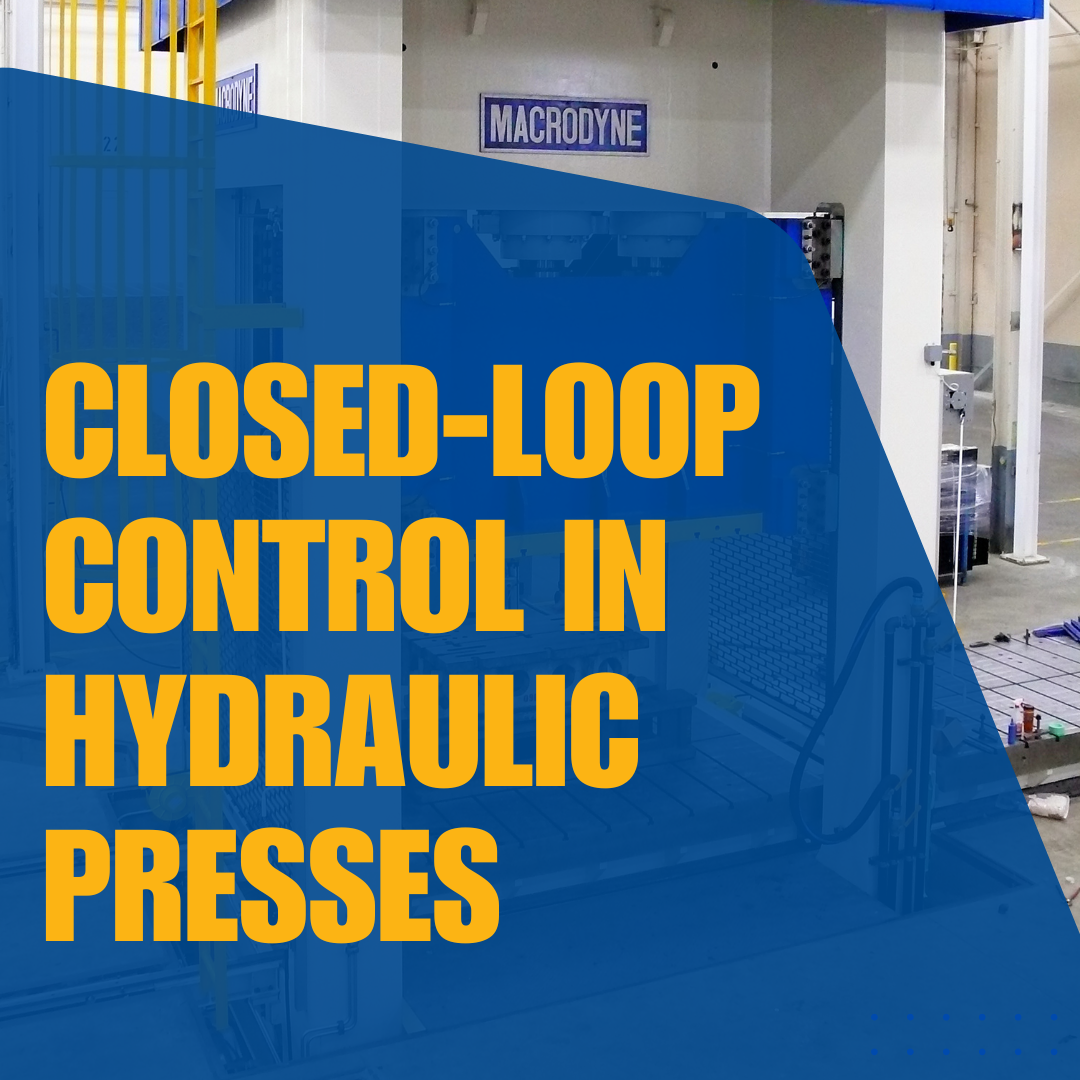
Closed-Loop Control in Hydraulic Presses
How feedback improves accuracy, repeatability and process control
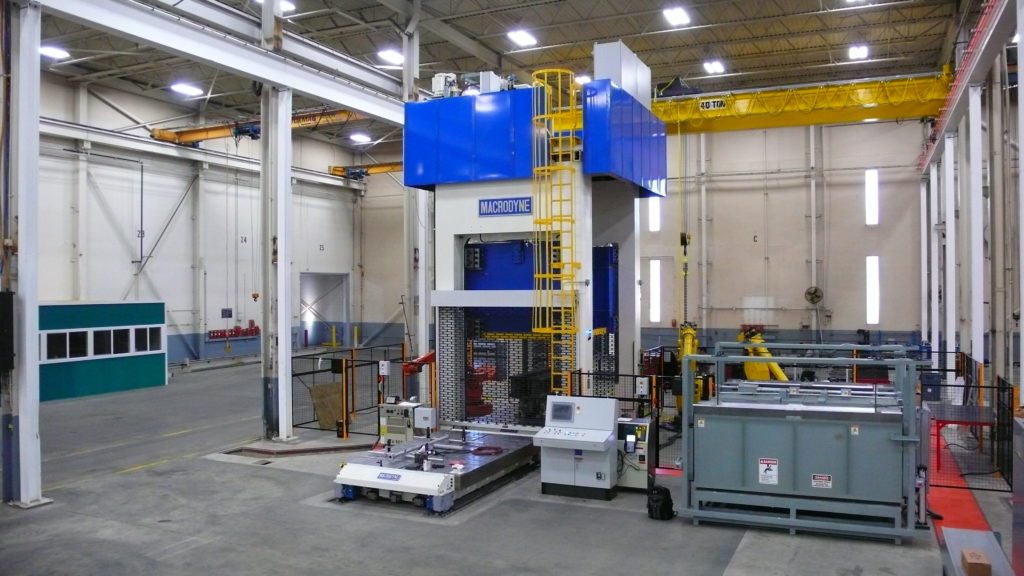
Closed-Loop Control in Hydraulic Presses and Why It Matters
No manufacturing process is perfectly consistent.
Material temperature changes. Lubrication varies. Incoming parts differ slightly. Tooling and operating conditions change how a press responds from one cycle to the next.
An open-loop press can issue the same command every time without guaranteeing the same result. Closed-loop control adds feedback, allowing the press to measure performance, compare it with the target and correct the process.
That distinction can be critical in hydraulic and servo-hydraulic press applications where force, position, speed or temperature must remain within a defined process window.
“Closed-loop process control is a process where you ask for a specific requirement, check whether you are getting it, and make a correction to reach that point,” explains Brett MacFarlane, Vice President of Operations and Engineering at Macrodyne Technologies.
Applying it effectively requires a clear understanding of the process, the variables that matter and what the control system can correct.
What is closed-loop control in a hydraulic press?
A closed-loop press control system continuously works through a feedback cycle.
- The control system receives a target, also called a setpoint.
- A sensor measures the press’s actual performance.
- The controller compares the measured value with the target.
- It calculates the difference, or error.
- The system adjusts the appropriate output to reduce that error.
- The measurement and correction cycle continues as required by the process.
MacFarlane uses a household oven to make the principle easy to understand.
“You set the oven at 350 degrees. It heats to that point and shuts off, but turns on again as needed to maintain 350 degrees.”
A press loop uses the same principle, although its response can be considerably more demanding. It may control ram position, forming speed, pressing force or another process variable.
In this context, closed-loop control refers to the feedback architecture used to control the press process. It should not be confused with a closed-circuit hydraulic system, which describes how hydraulic fluid circulates through a circuit.
Open-loop vs. closed-loop press control
The practical difference is whether the system verifies the result and responds to a deviation.
An open-loop controller sends a command to a valve, pump, motor or other device and assumes it produces the intended result. A closed-loop controller uses sensor feedback to verify the result and adjust the command when necessary.
“With closed-loop control, the system looks for a parameter and makes changes to reach it,” says MacFarlane. “With open-loop control, we send out the signal and do not make a correction. What we get is what we get.”
Open-loop control | Closed-loop control |
Sends a command without verifying the controlled result | Measures the actual result and compares it with the target |
Does not automatically correct process error | Adjusts the output to reduce process error |
May be appropriate for simple, mechanically constrained operations | Better suited to processes requiring controlled force, motion or temperature |
Generally requires less sensing, programming and tuning | Requires suitable sensors, control hardware, programming and tuning |
Open-loop operation is not inherently poor control. It may be entirely appropriate for a simple, mechanically constrained process. The right choice depends on what determines part quality and how much variation the process must absorb.
What variables can a press monitor and control?
A press can monitor many variables when the appropriate sensors and control architecture are in place. MacFarlane identifies four of the most common:
- Force or pressure to control how much load is applied during forming, forging, molding, assembly or testing
- Position to control the ram, slide, cushion or another axis at specific points in the stroke
- Speed to maintain a programmed motion profile as resistance changes
- Temperature when the process integrates heated tooling, platens, furnaces or material-temperature measurement
Other monitored conditions may include dwell time and force-versus-position behavior. Monitoring and controlling are not necessarily the same: a system might record temperature for traceability while actively closing the loop on force and position. The control strategy should distinguish between values used for correction, alarms and process records.
How does the system correct a deviation?
The controller first calculates the difference between the requested value and the measured value. This is the control error.
If the ram is moving more slowly than the programmed speed, the system detects a negative speed error and changes the command in the direction needed to increase speed. If measured force rises above the target, the controller makes the appropriate opposing adjustment to bring the process back toward the setpoint.
Stable control depends on tuning the loop for the dynamics of the press and process. A response that is too slow may not correct the deviation in time; one that is too aggressive may overshoot or oscillate. Sensor placement, controller response, hydraulic components, machine stiffness and material behavior all matter. Closed-loop control is an engineered part of the system – not merely a software option.
How closed-loop control improves part quality and repeatability
Closed-loop control is particularly useful when the input conditions are not identical from cycle to cycle.
“If a product enters the press at, say, a different temperature or with a different amount of lubrication, it may create a slightly different motion each time. Closed-loop motion control can compensate for that,” says MacFarlane.
In a forming operation, variable lubrication can change how easily material moves through the tool. Repeating the same output command may then produce a different speed, force development or endpoint. Feedback allows the press to adjust its response and remain closer to the programmed profile.
That can improve consistency in several ways:
- More repeatable force, pressure, speed and position from cycle to cycle
- Better control of the process endpoint
- Reduced dependence on manual operator correction
- Earlier detection of conditions that move outside the permitted process window
- More useful process data for troubleshooting and quality review
Closed-loop control does not eliminate variation. It helps the press respond consistently to defined variation, provided the disturbance remains within the range the process was designed to handle.
Why it matters in defense manufacturing
Closed-loop control can be especially relevant in defense manufacturing, where repeatability and process documentation often matter as much as production capacity. Applications may include forging, drawing and nosing ammunition components; straightening barrels, tubes or shafts; forming aerospace and vehicle structures; and compression molding composite parts.
An open-die forging operation, for example, may depend on the press stopping at a controlled position rather than against fixed mechanical stops. A forming line may monitor force and position to determine whether each cycle remained inside an approved process window.
Closed-loop control can support traceability, but it does not create it. Process data must be captured, stored and associated with the correct part, batch or cycle.
What closed-loop control cannot correct
“Closed-loop control corrects up to the point you have asked it to correct to,” MacFarlane explains. “If you are trying to make a part at 1,000 tons, but the process actually requires 1,100 tons, the machine will not know it needs to go to 1,100 tons. You have limited it.”
The controller follows the target and limits it has been given. It cannot determine that the specification is wrong or compensate for every mechanical or material problem, including:
- A press that does not have enough force, speed or stroke for the application
- Incorrect setpoints or an inadequately developed process recipe
- Uneven, damaged or misaligned tooling
- Faulty or poorly located sensors
- Mechanical wear, excessive deflection or hydraulic problems beyond the control system’s correction range
- Incoming material or temperature conditions outside the validated process window
If the objective is a particular part thickness but the tooling is not level, for example, regulating force or position cannot correct the underlying geometry problem.
Closed-loop control makes a capable process more consistent. It does not make an incapable process viable.
Does every press operation need closed-loop control?
No. The required level of control should be determined by the application.
A simple process that closes against hard stops while a material cures may rely primarily on tool geometry. If the press does not establish the critical endpoint, sophisticated motion control may offer little benefit.
By contrast, a process that relies on the press to stop at a programmed position or follow a defined force, speed or position profile is much more dependent on accurate feedback and correction.
The useful question is whether the press must actively control a variable that determines the process outcome.
Specifying closed-loop control for a new press or retrofit
For a new press, requirements should be defined early enough to influence the sensors, hydraulics, controller, valves or drives, data collection and acceptance testing.
A retrofit also requires an assessment of the existing machine. It is rarely just a PLC change. New transducers, more controllable hydraulic components, updated controls, data acquisition or mechanical and hydraulic repairs may be required.
Before specifying a new system or retrofit, manufacturers should be able to answer several questions:
- Which process variable must the press control?
- What is the target, tolerance and acceptable response time?
- What sources of variation must the loop accommodate?
- Where and how will the actual value be measured?
- What should happen if the process cannot reach or maintain the target?
- Which values must be recorded for quality or traceability?
- How will the control strategy be tuned, validated and maintained?
Accuracy has an engineering cost
Closed-loop control requires additional sensing, programming, commissioning and tuning, and can demand more from those operating and maintaining the equipment.
“Closed-loop control is a more expensive process,” says MacFarlane. “It’s more accurate, but it requires more tuning and more control. The setup costs are higher, but in the end, it can give you a better and more consistent product.”
The business case is strongest when it addresses a measurable need: tighter tolerances, less variation, lower scrap, fewer manual adjustments or better process documentation. Closed-loop control should be specified when feedback and correction are necessary, not simply because the technology sounds advanced.
Choosing the right level of press control
Effective closed-loop control begins with the process, not the controls cabinet.
Manufacturers must define what the part requires, which variables influence the result and how much variation the system must manage.
When requirements are clear, closed-loop control gives hydraulic and servo-hydraulic presses the feedback needed to hold critical variables closer to target. If the process is poorly defined, the tooling is inadequate or the machine lacks capability, no control algorithm can fill the gap.
If you would like to learn more about closed-loop control and whether it could benefit a new or existing press application, contact Macrodyne to discuss the process requirements with an engineer.