 Your customer needs more parts. Sooner.
The press has the tonnage. The quoted cycle time suggests there’s room to increase output. On paper, the numbers look pretty good. One question to consider, though: can the rest of the factory keep up?
That’s where production commitments get tested. Material delivery, tooling, handling, staffing, maintenance and inspection all have to support the higher rate. One constraint can put the entire schedule at risk.
The U.S. Army is preparing to put that problem under pressure. On October 12, 2026, it announced plans for a “Manufacturing Rodeo” in early 2027, designed to expose weaknesses in manufacturing processes and supply chains across its industrial base with this supply chain stress test. The objective is practical. Find the weak links, strengthen them and repeat in order to meet wartime surge capacity.
It follows months of pressure to increase defense production. In July, Reuters reported calls to expand manufacturing capacity as conflicts strained U.S. stockpiles and exposed industrial bottlenecks.
You don’t have to manufacture defense components for the question to matter. How much more can your line produce while still meeting quality requirements and delivery commitments?
To answer that, you need to look at everything that happens before, during and after the press cycle.
“The press may have capacity to spare, but if you’re waiting on material, a die change or an inspection result, that capacity isn’t translating into parts,” says Jeff Walsh, Director of Business Development at Macrodyne. “Before you commit to higher output, you need to know what will limit the line and whether you can sustain the required rate across shifts.”
Put a Number on the Surge
“More production” isn’t a target you can engineer around. A 20% increase on one component over six months is a different challenge from doubling weekly output across several components with little notice.
Define what the line needs to deliver. How many acceptable parts per shift? Which materials and components? How quickly does production need to increase, and how long does that rate need to hold?
Then check what it takes to get there. Additional shifts need people. Higher material consumption needs confirmed supply. Longer operating hours need maintenance coverage. More parts need inspection capacity. If the plan depends on resources you don’t have, you haven’t established the capacity.
Measure the Whole Cell Cycle
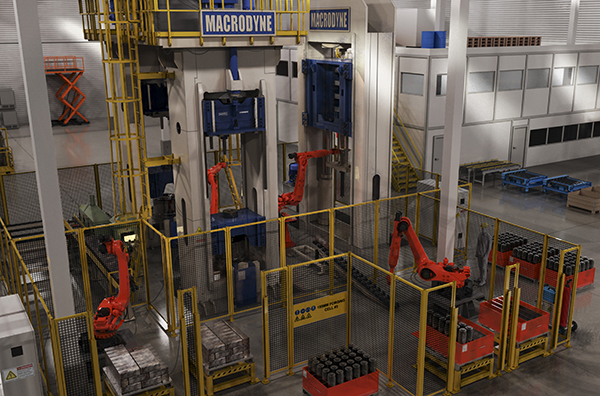
The press cycle is only part of the production cycle. Material has to enter the cell and reach the correct position. The press has to complete the forming sequence. The finished part has to clear the tooling before the next cycle can begin.
Some steps can overlap. Others just can’t. That sequence determines how often the cell delivers a completed part.
Let’s look at a simplified example. The press completes its cycle in 20 seconds. Loading, unloading and required checks add another 15 seconds that can’t overlap. That’s one part every 35 seconds, or approximately 103 parts per hour before downtime and rejects. Calculate from the press cycle alone, and you get 180. That gap belongs in the capacity plan before it becomes a missed delivery.
“When we evaluate a production target, we need to account for every step that’s required to deliver an acceptable part,” says Kevin Fernandes, President of Macrodyne. “The press, tooling, handling and controls have to work together at that rate. That’s what the acceptance test needs to demonstrate under agreed production conditions.”
Measure sustained output with representative parts, tooling and handling conditions. A few fast cycles won’t tell you what the cell can deliver across a shift.
Keep Material Moving in Both Directions
An empty press isn’t producing. Neither is a press waiting for someone to remove the finished part. At the proposed surge rate, check how material reaches the cell and how parts leave it.
Can blanks be prepared and staged fast enough? Does the line share a forklift or crane with three other operations? Can the handling equipment accommodate every planned component? Who changes full bins and clears scrap, and how often?
Then follow the part through the rest of the factory. Heating, trimming, machining, washing, heat treatment and packaging all have capacity limits. Batch operations add another complication. An average hourly rate can look adequate while parts spend hours waiting for the next available batch.
Increasing press output can simply move the backlog downstream. Identify where work will accumulate, how much buffer you can accommodate and what happens when that space fills.
Every machine can meet its individual specification and the line can still miss its production target. The interfaces matter. What tells the press that the part is correctly positioned? What happens when downstream equipment stops? How does the sequence recover?
Someone needs responsibility for how the complete system operates. Define that ownership before equipment is ordered.
Don’t Stop the Changeover Clock too Early
The die is installed, but that doesn’t mean the line is ready to produce. Connections, recipe selection, adjustments and first-piece approval still take time. So do tool retrieval and preparation before installation begins.
Measure the full changeover, from the last acceptable part of the outgoing run to the first approved part of the next. Then look at what’s consuming that time. Are tools ready before the machine stops? Is lifting equipment available? Can the next shift repeat the setup without calling someone at home? If a quality technician has to approve the first part, are they available when production needs them?
A line that performs well on long runs can lose substantial capacity when the product mix changes.
Getting changeovers under control can recover production time without taking a second off the forming cycle.
Make Flexibility Repeatable
A press may be capable of forming several components. The line still needs a reliable way to switch between them. Different parts can require different force profiles, speeds, stroke positions, dwell times, cushion settings and handling sequences. Inspection requirements can change, too.
Stored recipes help, but saving a set of parameters doesn’t prove the process. Validate those recipes against the intended materials, tooling and components. Make sure operators can select the correct version and that changes to approved settings are controlled.
Then test the transitions. Can the line change components and return to stable production predictably? If every changeover depends on one experienced person adjusting settings from memory, your capacity depends on that person being available. That’s a dependency you need to address before increasing output.
Staff the Entire Operation
Adding a shift takes more than adding a press operator. Material handling, setup, maintenance, quality and controls support all need coverage. Map the skills required to run the line and keep it running through breaks, absences and interruptions.
Automation can reduce repetitive handling and improve consistency. It still needs people who know how to recover the process when something stops. Who clears a misfeed? Who resolves an inspection fault? Who can diagnose a controls issue and restart the cell safely?
Answer those questions for every shift. An extra eight hours on the schedule only creates capacity if the operation has the support to use them.
Plan for the Machine That Goes Down
A surge puts more operating hours on equipment and tooling. Your maintenance plan needs to reflect that duty. Check service intervals, wear components, access for maintenance and critical spares. Confirm replacement lead times before a failed component makes them urgent.
Deferring maintenance to protect the schedule can leave you with a longer, unplanned interruption.
Then work through the failure scenario. If one essential machine goes down, what happens to the rest of the line?
Identify the failures that stop production, the likely recovery time and the alternatives available. Can another machine take the work? Is the tooling compatible? Is the alternative process approved? Can it meet the required quality and output? A spare machine doesn’t provide backup capacity until those questions have answers. Know how you’ll recover before the line stops.
Count Parts You Can Release
A part leaving the press isn’t necessarily a part you can ship. Measurement, testing, traceability and approval all need to keep pace. Otherwise, production creates a growing queue of parts waiting for release. So check inspection equipment, staffing, sampling requirements and review time. Make sure required data can be captured and linked to the correct part or batch at the planned rate.
If every record needs manual entry or every result waits for one person’s approval, include that workload in the capacity calculation.
Measure acceptable output and the resources needed to verify it. Faster production won’t improve delivery if quality can’t release the parts.
And if the higher rate creates more defects, rework and investigation will consume capacity elsewhere in the factory.
Make the Supplier Prove the Production Assumptions
A production target needs more support than a quoted press speed. Your equipment supplier needs to understand the application, examine the complete process and explain the assumptions behind the proposed output. That means working through representative materials, tooling, handling, controls and the intended product mix. It also means agreeing on what the equipment must demonstrate before you accept it. Define:
- The required output of acceptable parts and the test duration.
- The materials, tooling and component variants included.
- The staffing, handling and utility conditions.
- The quality, inspection and traceability requirements.
- How changeovers, interruptions, rejects and recovery time will be recorded.
Be clear about what can be proven at the supplier’s facility and what needs to be verified after installation and integration at your plant.
Those details belong in the specification and acceptance criteria from the start.
At Macrodyne, we bring press design, automation, controls and integration into the same engineering conversation. Your production requirements guide how those elements work together, from the forming sequence to material handling and changeovers.
That gives your team a clearer basis for a major equipment decision. What will the system deliver? Under which operating conditions? How will that performance be tested? And who’s responsible for making it work?
Those answers belong in the project before the equipment reaches your floor.