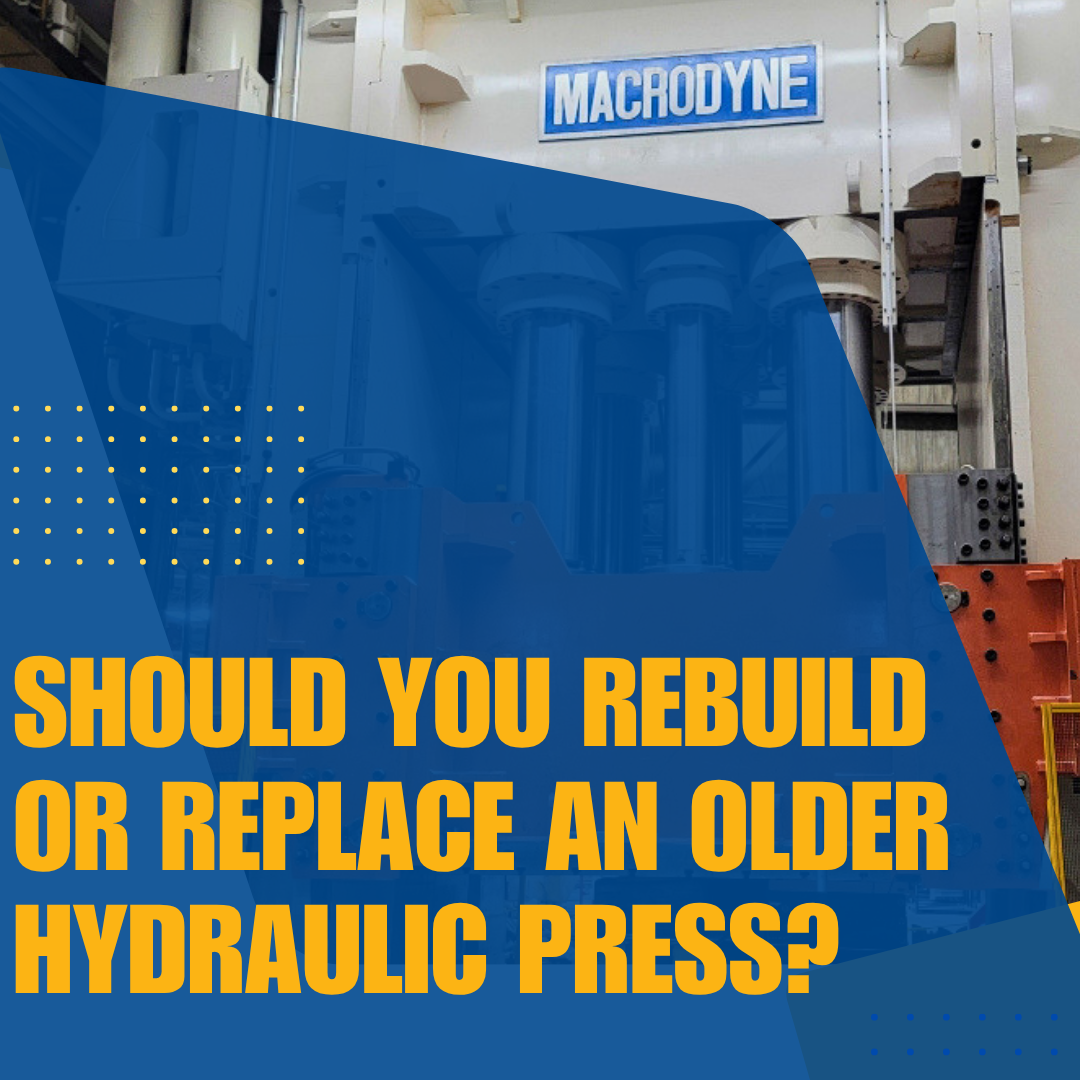
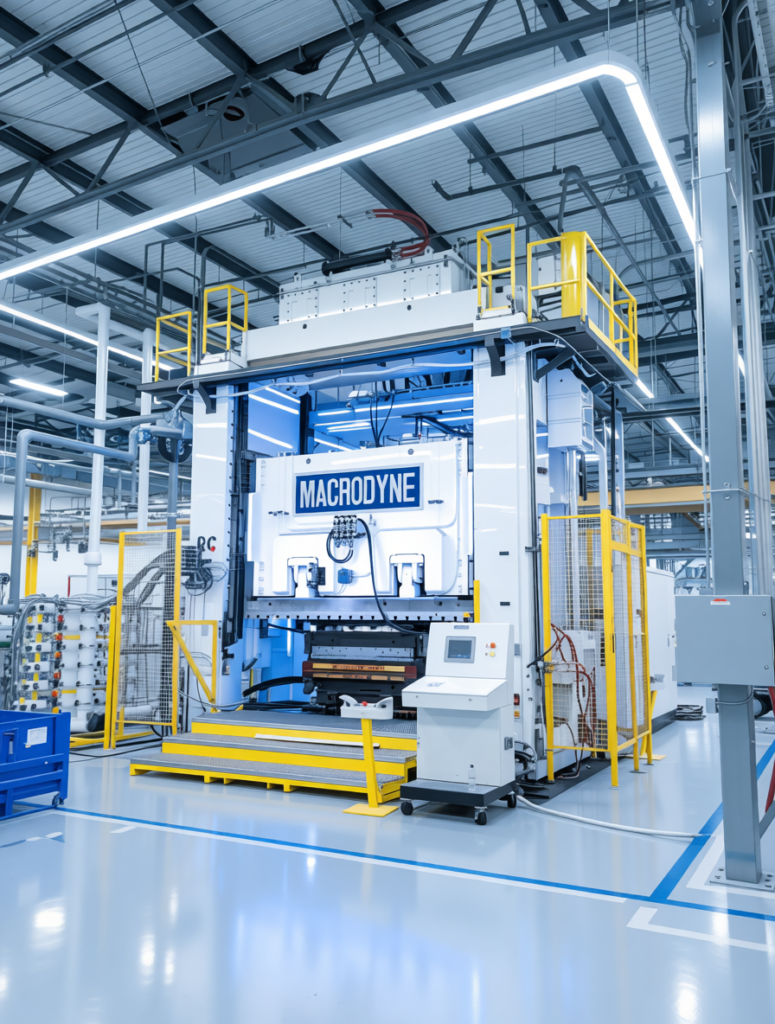
An older hydraulic press can be a strange thing.
It may leak a little. It may sound a little rougher than it used to. The controls may feel like they belong in a museum with very specific lighting. But it may also still be doing the job, day after day, with a heavy-duty frame that has more structural integrity than some newer machines on the market.
So the question is not simply: Should we rebuild it or replace it?
The better question is: Is this press still the right machine for the work ahead?
That is where the decision becomes more useful.
Because choosing machinery remanufacturing or rebuilding an older hydraulic press can be a smart, cost-effective way to extend the service life of a proven asset. On the flip side, purchasing a new hydraulic press can be the more financially responsible decision when the equipment no longer supports your production requirements, plant safety expectations, industrial automation plans, or long-term manufacturing reliability goals.
“A rebuild-or-replace decision should never start with the age of the press,” says Jeffrey Walsh, Director of Business Development with Macrodyne Technologies. “It should start with the condition of the machine and the demands of the process.”
Start with the Real Issue: Downtime and Obsolescence
Most manufacturers do not start researching hydraulic press rebuilds and upgrades because everything is going beautifully. The conversation usually starts when something feels off on the factory floor.
Maybe unscheduled downtime is becoming harder to ignore. Maybe critical replacement parts are getting difficult to source. Maybe the industrial control systems are outdated. Maybe the press still runs, but your operators and maintenance teams have quietly built a whole survival system around its quirks.
That is often the moment when the rebuild vs. replace hydraulic press decision starts to take shape.
But before comparing equipment quotes, lead times, or capital budgets, it helps to define the exact type of intervention being considered.
Repair, Retrofit, Rebuild and Replacement Are Not the Same Thing
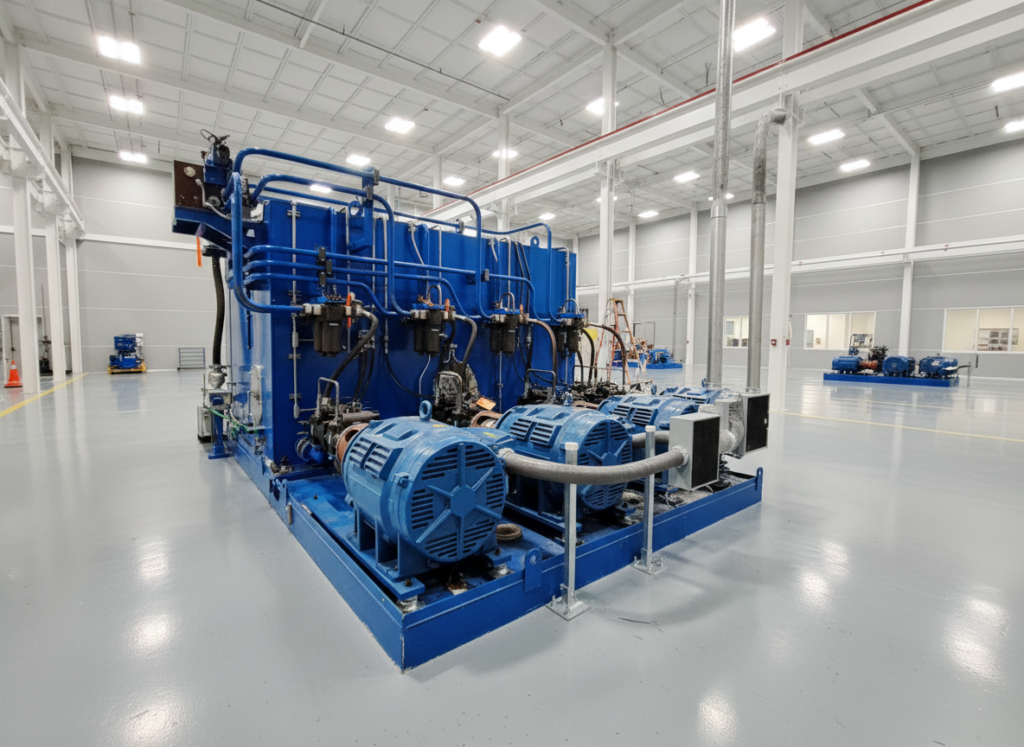
These terms are often used interchangeably in the manufacturing industry, but they solve entirely different problems.
Hydraulic Press Repair
A repair addresses a specific mechanical failure or worn component. This could include hydraulic press cylinder repair, seal replacement, hose replacement, valve rebuilding, pump repair, or troubleshooting an electrical issue.
A standard repair is about restoring immediate function. It gets the press running again, but it does not fundamentally change the machine. While perfectly appropriate for routine maintenance, it can become an expensive habit if the same operational problems keep coming back.
“There is nothing wrong with repairing a press,” explains Walsh. “The risk comes when repeated repairs start replacing a real lifecycle decision.”
Hydraulic Press Retrofit
A hydraulic press retrofit adds modern technology to an existing machine frame. This typically includes upgrading to new PLC controls, updated HMIs (Human-Machine Interfaces), proportional servo valves, modern sensors, automated data collection, recipe control, or servo-hydraulic press upgrades.
A retrofit is often the right path when the press structure is still sound, but the control system, hydraulic system, or safety architecture no longer meets current production needs. In plain terms: the bones are good, but the nervous system needs work.
“A retrofit makes the most sense when the structure is still doing its job, but the controls, hydraulics, or safety systems are no longer keeping up,” says Walsh.
Industrial Press Rebuild
A full hydraulic press rebuild is a much deeper technical intervention. It involves a complete teardown, detailed inspection, repair, replacement, and modernization of major systems, including the frame, ram, cylinders, hydraulic power unit (HPU), electrical system, controls, safety guarding, and operator interface.
A rebuild can restore the machine to its original Original Equipment Manufacturer (OEM) specifications or even improve performance. This is where press modernization becomes more than simple maintenance. It becomes a core lifecycle strategy.
Full Equipment Replacement
Hydraulic press replacement means starting over with a new machine designed around your current and future production requirements.
A new press may be the better path when the existing machine has structural issues, outdated geometry, limited automation potential, poor safety upgrade feasibility, or simply can no longer form the parts being produced. Replacement is not automatically the “premium” option.
Sometimes it’s just the more practical one.
The Press Frame Decides More Than People Think
If there is one place to start your evaluation, start with the frame.
Hydraulic systems, pumps, cylinders, valves, seals, hoses, electrical panels, and controls all age. Under heavy production loads, many of these systems will need TLC within 15 to 25 years.
The press frame is different. A well-built hydraulic press frame can often remain viable for decades, provided it has not suffered structural cracking, distortion, metal fatigue, excessive deflection, or catastrophic alignment issues.
This is why an older hydraulic press should not be dismissed just because of its age. Some older presses were built with extremely heavy cast or welded steel construction. In many cases, that mass and rigidity are massive assets for high-tonnage applications. If the “iron” is still sound, the press is an excellent candidate for a hydraulic press rebuild, retrofit, or controls upgrade.
But there is a hard limit here:
- No control system can fix a compromised structure.
- No new HMI can solve frame distortion.
- No servo-hydraulic upgrade can magically overcome bad alignment or cracking.
That is why a professional structural press inspection should always come before any serious rebuild-or-replace decision. Not after. Before. It is less fun than shopping for brand-new equipment, but it is how you avoid making a very expensive capital mistake.
When Rebuilding and Modernization Makes Sense
A rebuild is often the right path when the existing press still has strong structural value and remains well-matched to your manufacturing applications. This is often true when the main issues are related to hydraulics, controls, safety, reliability, or component maintainability rather than the core structure itself.
A hydraulic press rebuild makes sense when:
- The frame, bed, ram, and major structural components are perfectly sound.
- The press still features the right tonnage, bed size, stroke, daylight, and geometry.
- Your production process has not outgrown the capacity of the machine.
- The main issues are outdated controls, sluggish hydraulic performance, or component wear.
- Production downtime can be planned around the rebuild schedule.
- You want to extend the life of a proven asset while conserving capital expenditure.
- The machine can be upgraded to support better repeatability, monitoring, and closed-loop process control.
In these cases, industrial press refurbishment delivers real value. Not because it makes an old press look shiny and new, but because it makes the machine more reliable, controllable, safe, and useful for the work it needs to do.
When a New Hydraulic Press is the Better Decision
Replacement becomes worth considering when the existing press no longer fits the evolution of your operation. That does not always mean the press has failed. In fact, the hardest decisions often involve machines that still cycle every day. They just don’t run well enough anymore.
Investing in a new hydraulic press is often the better long-term decision when:
- The frame is cracked, distorted, fatigued, or outside acceptable tolerances.
- Ram and bed alignment issues are actively affecting part quality and causing scrap.
- The press no longer supports current part sizes, modern materials, tight tolerances, or fast cycle-time requirements.
- Safety upgrades would be too extensive, awkward, or structurally compromised.
- Industrial automation integration (like robotic loaders or coil lines) would require too many complex workarounds.
- Maintenance costs and labor hours are increasing year after year.
- Original replacement parts are completely obsolete or difficult to source.
- Operators are constantly compensating for machine limitations.
- The company needs advanced data logging, part traceability, automated recipe systems, remote diagnostics, or precision closed-loop control.
A rebuild can restore a press, but it cannot always turn it into the advanced machine your operation now requires to stay competitive. If the press is fundamentally mismatched to your future production plan, rebuilding may only delay the inevitable.
And that can be more expensive than it looks on paper.
Total Cost of Ownership (TCO): Looking Beyond Upfront Costs
Yes, rebuilds often cost less upfront than new equipment. In many cases, a hydraulic press retrofit can cost significantly less than buying a comparable new machine. That makes rebuilding incredibly attractive to finance teams.
But upfront cost is only one variable. The better metric to look at is the Total Cost of Ownership (TCO) and overall return on investment (ROI).
When evaluating costs, make sure to calculate:
- Planned vs. unplanned downtime
- Ongoing maintenance labor and specialized technician fees
- Spare parts availability and costs for obsolete systems
- Material scrap rates and part rework
- Energy consumption (older hydraulic power units are notoriously inefficient)
- Operator efficiency and ergonomic safety
- Industrial automation readiness and production bottleneck risks
A rebuild that looks inexpensive on paper may become incredibly costly if it leaves your operation with ongoing downtime or automation constraints. Conversely, a replacement that looks expensive upfront may be easier to justify if it eliminates your maintenance burden, improves throughput, and gives your business a stable production platform for the next 20 to 30 years.
Controls, Safety, and Automation Can Change the Answer
Many older hydraulic presses were built for a vastly different manufacturing environment. They were not designed around today’s strict expectations for automated part handling, data collection, ERP traceability, or safety interlocks.
However, a hydraulic press controls upgrade can completely transform how an older press performs. Modern PLCs, HMIs, and sensors make the machine easier to operate, monitor, and troubleshoot. Furthermore, a servo-hydraulic press upgrade can dramatically improve energy efficiency by allowing the system to draw power intelligently only when needed during the press cycle, rather than running a massive pump continuously.
Don’t Treat Safety as an Afterthought
Safety upgrades should never be treated as a final checkbox. Older presses often require new physical guarding, light curtains, safety interlocks, two-hand controls, emergency stop systems, and safety PLCs.
If safety improvements are extensive enough to reshape the machine’s layout, that needs to be part of your rebuild vs. replace decision from the beginning, not after the budget has been approved, and certainly not during the teardown phase.
Questions to Ask Before Choosing Your Path
Before committing capital to a rebuild, retrofit, or replacement, walk through this checklist with your engineering and maintenance teams:
- Is the press frame structurally sound and free of cracks?
- Are the bed and ram aligned within acceptable OEM tolerances?
- Does the press still match the dimensions and tonnage of the parts we need to produce?
- Are our recurring issues mainly hydraulic, electrical, mechanical, or structural?
- Are OEM replacement parts still available, or are we relying on custom-machined workarounds?
- Can modern safety guarding and light curtains be integrated cleanly?
- Can the press support robotic automation or feed lines without major compromise?
- Do our customers require advanced data logging, recipes, or closed-loop process control?
- How much production downtime can our operations realistically absorb right now?
- Will this decision still make operational and financial sense five to ten years from now?
The Bottom Line on Hydraulic Press Modernization
An older hydraulic press should never be judged by age alone. A structurally sound machine can have decades of productive life left with the right hydraulic press rebuild, controls upgrade, safety modernization, or servo-hydraulic retrofit.
But if the press no longer fits your manufacturing process, creates recurring downtime, limits automation, compromises safety, or cannot support future production growth, replacement is the more responsible long-term decision.
The point is to make a data-driven decision that is practical, defensible, and based on the actual structural condition of the machine.
Need a Clearer Path Forward?
Macrodyne supports both manufacturing outcomes: we engineer custom, high-performance new hydraulic presses and deliver comprehensive press modernization programs for existing industrial machinery assets.
Contact Macrodyne today to schedule a professional structural press evaluation. Let us help you determine whether your machine is a strong candidate for a rebuild, retrofit, or replacement, before capital is committed and before production risk gets any more expensive.