
The AI boom is accelerating faster than the manufacturing systems supporting it. While computing power continues advancing rapidly, the physical infrastructure required to build, cool, power, and deploy AI hardware is placing enormous pressure on industrial production environments.
Demand for power transformers has increased 119% since 2019, with lead times now stretching up to 5 years. It’s a stark illustration of how the digital economy is being throttled by analog reality.
This is the Physical Wall. It’s the point where exponential ambition collides with finite factory capacity, material lead times, and the unforgiving tolerances of precision engineering. The most urgent AI data center infrastructure challenges aren’t being solved in data centers or design labs. They’re being solved on the shop floor through advanced precision metal forming and machining.
At the core of this bottleneck is a manufacturing problem defined by three demands: quality, flatness and repeatability at scale. Thermal management hardware, structural enclosures, and cooling systems must meet exacting specifications consistently, and across thousands of units. Processes like precision thermal forming are no longer peripheral to AI deployment. They’re foundational to it.
Behind the rapid expansion of AI infrastructure sits a manufacturing ecosystem under growing pressure to scale. Cooling systems, thermal assemblies and precision-formed components are becoming increasingly critical…and increasingly difficult to produce consistently at volume.
The first challenge driving that shift is heat.
The Thermal Crisis: Why Liquid Cooling Manufacturing is the New Frontier
The chips powering today’s AI workloads don’t just run hot. They generate heat at a scale that fundamentally breaks traditional cooling assumptions. NVIDIA’s A100 and newer architecture can exceed 1,000 watts of thermal design power per chip. Air cooling, which moves heat by pushing air across fins and heatsinks, simply can’t remove that much energy fast enough. The physics aren’t negotiable.
That reality is reshaping the entire AI infrastructure market growth story. Cooling is no longer a background concern. It’s a first-order design constraint forcing a massive shift toward specialized cold plate manufacturing.
From Air to Liquid: A Market in Rapid Transition
The numbers reflect just how fast this shift is happening. By 2026, the latest widely cited TrendForce forecast had liquid cooling penetration in AI data centers projected to reach 33% in 2025, underscoring how quickly the market was shifting. That’s not a gradual evolution. It’s an industry forced to pivot under pressure.
Liquid cooling works by circulating coolant directly through metal cold plates mounted flush against the chip. Heat transfers into the liquid rather than the air, enabling far greater thermal density per rack. Where air-cooled racks might handle 10–20 kW, liquid-cooled systems can support 100 kW or more.
Precision as the Price of Entry
Here’s where the hardware manufacturing challenge becomes acute. A cold plate isn’t simply a metal part. It’s a high-precision thermal instrument. The micro-channels machined into its surface must maintain exact geometry to ensure uniform coolant flow and consistent heat transfer. Next-generation cold plates require extremely tight tolerances — often around ±0.02 mm — where even minor dimensional inconsistencies can impact thermal performance.
Achieving that level of repeatability demands not just precise CNC machining, but controlled bonding and forming processes. Advanced hydraulic press technology plays a critical role here, providing the controlled, uniform force needed to bond cold plate assemblies without introducing warps or voids that compromise thermal performance.
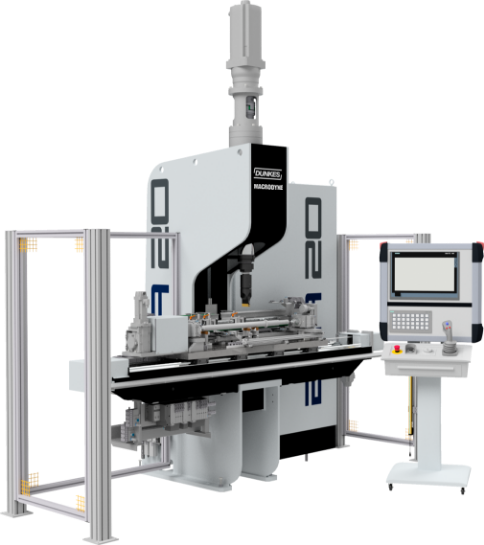
“At low production volumes, manufacturers can often compensate for distortion manually,” says Timo Kollmann, DUNKES’ CEO. “But as throughput increases, even small dimensional inconsistencies begin creating downstream problems very quickly. In thermal management manufacturing especially, flatness and repeatability directly impact assembly stability, thermal performance and production efficiency.”
Getting precision right at the prototype stage is one thing. Sustaining it at production scale is an entirely different problem.
And that’s exactly where the next challenge begins.
The Gap Between Prototype and Deployment
Knowing how to build a liquid cooling cold plate is a solved problem. Building 100,000 of them — with identical flatness tolerances, consistent bonding integrity and zero defects — is an entirely different challenge. This is where the data center supply chain breaks down, and where most engineering roadmaps quietly underestimate the difficulty ahead.
As Rajat Bhagat of Arcadis put it plainly in a recent industry discussion: “The challenge is not the knowledge of the technology; it’s the Industrial scale deployment of liquid cooling.” That distinction matters enormously. Proof-of-concept and pilot production are manageable. Sustained, high-volume manufacturing is where complexity compounds fast.
Production drift becomes one of the biggest risks. Processes that remain stable during prototype or pilot production often begin introducing variability under sustained throughput conditions. Flatness deviations grow. Manual corrections increase. Cycle times fluctuate. Rework accumulates. Over time, production instability starts impacting deployment schedules.
Traditional fabrication methods weren’t designed for this level of precision at scale. Flatness deviations that are acceptable in a general context become critical failure points when a cold plate must make uniform contact across a high-density GPU package. Repeatability isn’t a nice-to-have. It’s the product. Small process variations, multiplied across hundreds of thousands of units, translate directly into thermal failures and rejected assemblies.
This is also where precision straightening and flatness correction processes are becoming increasingly important within AI infrastructure manufacturing. Residual stress, forming distortion, welding variation, and thermal exposure can all introduce dimensional instability into critical components. At scale, manufacturers are under growing pressure to recover flatness and maintain repeatability without slowing throughput.
Then there’s the Timing Problem.
Data center construction operates on rigid schedules tied to multi-billion dollar commitments. When cooling component production lags (even by weeks!), it can stall rack deployment across an entire facility.
The downstream costs are mind-blowing.
What closes this gap is automated, high-throughput industrial press equipment capable of maintaining tight tolerances across long production runs. Processes like precision flat pressing are increasingly central to producing the consistent, defect-free components that liquid cooling at scale demands. That production capability is exactly what the next section examines in depth.
Scaling the AI Production Layer: How Domestic Manufacturing Builds the Backbone
The conversation around AI infrastructure has focused heavily on software, chips and data centers, but the supply chain holding it all together is increasingly physical, local and precision-driven. As geopolitical pressures reshape global sourcing, domestic manufacturers are stepping into a critical role: building the components that make AI hardware actually function at scale.
“What many manufacturers are facing right now is not a technology problem,” says Kevin Fernandes, President of Macrodyne Technologies. “It’s a scalability problem. The challenge is maintaining precision, repeatability and throughput simultaneously as production volumes accelerate. That’s where integrated forming systems and automation become critical.”
- Precision: Liquid cooling manufacturing demands tolerances that leave no room for improvisation. Custom hydraulic and servo presses deliver the controlled, repeatable force profiles needed to produce cold plates and heat exchangers that meet exacting flatness specifications — the kind of specs where a few microns of deviation can compromise an entire thermal assembly.
- Repeatability: According to Scailium Insights, the AI Production Layer is the missing infrastructure behind industrial scale-up, requiring specialized factory-floor intelligence. What that means in practice is that knowing how to make a part isn’t enough. Manufacturers need embedded process insight to replicate quality across thousands of production cycles without drift.
- Throughput: Moving beyond prototype-stage thinking requires production systems that don’t just perform. They need to perform consistently, and under load. Processes like high-pressure compression forming illustrate how matched tooling and press control translate directly into throughput gains for complex, high-tolerance components.
Increasingly, manufacturers are also looking to reduce integration risk by consolidating forming, straightening, handling, and automation systems into more unified production environments capable of maintaining stability under scale.
Domestic production is fast becoming a prerequisite for any AI hardware roadmap that needs to move at deployment speed. The next question is whether the presses and tooling behind these components are precise enough to meet the bar AI infrastructure demands.
Why Industrial Press Solutions Matter
Manufacturers have made real progress closing the gap between prototype and production.
But it comes with a big caveat: the machinery doing the forming, bonding and laminating still determines whether that progress holds. When it comes to AI hardware components, relying on experienced hydraulic press manufacturers isn’t a luxury. It’s the difference between a product that performs and one that fails in the field.
Here are three specific technical requirements of AI hardware and how advanced press technology meets them:
- Flatness tolerances for thermal contact: Cold plate assemblies require near-perfect surface flatness to maximize contact with heat-generating chips. Cold plate assemblies require extremely high surface consistency to maximize thermal contact with heat-generating chips. Even small inconsistencies in pressure application or ram parallelism can introduce micro-gaps that reduce cooling efficiency and create downstream performance issues at scale.
- Repeatable bonding for composite enclosures: Structural AI hardware components, such as chassis, enclosures and mounting systems, demand consistent pressure profiles across every cycle. Hydraulic presses with closed-loop feedback maintain those profiles reliably, even across high-volume production runs. In practice, variance between parts compounds quickly at scale.
- Reduced cycle times for critical-path components: Automation integrated into modern press systems directly cuts lead times on components that sit on the critical path of every data center build. Macrodyne and DUNKES’ servo and hydraulic platforms — including presses designed for energy-critical components — support automated loading, real-time monitoring, and repeatable force control that keeps production moving.
‘Good enough’ manufacturing just doesn’t survive contact with AI hardware specs. A warped cold plate or a delaminated composite panel doesn’t just underperform. It triggers a supply chain failure that delays entire facility deployments.
The question facing manufacturers isn’t whether precision matters. It’s whether they are equipped with the heavy infrastructure and precise machinery required to deliver it consistently.
As AI infrastructure manufacturing continues scaling, the pressure on production environments will only increase. Manufacturers capable of maintaining precision, flatness, repeatability, and throughput simultaneously will be the ones best positioned to support the next phase of deployment.

Macrodyne and DUNKES work with manufacturers building complex, high-precision production environments where forming, straightening, automation, and production stability all need to work together under sustained demand.
To learn more about our hydraulic press, servo press, automation, and straightening capabilities, contact our team.