
The press was rated for 500 tons. But the part still cracked.
Nothing was “wrong” on paper. Tonnage was sufficient, tooling looked fine, and the press was operating within limits. But the force showed up at the wrong point in the stroke.
This is where most press problems actually start.
Press force is often reduced to a single number: peak tonnage on a nameplate. It’s simple. It’s familiar. And it’s incomplete. But the nameplate tonnage has become manufacturing’s most misleading comfort blanket.
It feels authoritative. It feels precise. And it quietly hides what the press is actually doing through most of the stroke.
In real manufacturing environments, how force is applied throughout the press stroke matters far more than the maximum tonnage a press can theoretically reach. Part quality, tooling life, process stability, and usable energy are all governed by the force curve — the relationship between press load and stroke position as the ram travels from top to bottom.
A press does not deliver full force instantaneously, nor does it apply force uniformly across the stroke length. Understanding press force throughout the ram stroke is the difference between a process that runs predictably and one that fights inconsistency, scrap, and downtime.
“If press selection was as simple as matching tonnage numbers, forming would be easy,” says Kevin Fernandes, President of Macrodyne Technologies. “In reality, the force curve matters more than the headline rating ever will.”
Servo Press Force Control
The impressive speeds of today’s hydraulic presses are not accidental. They are the result of decades of innovation in hydraulic components, control systems and mechanical design.
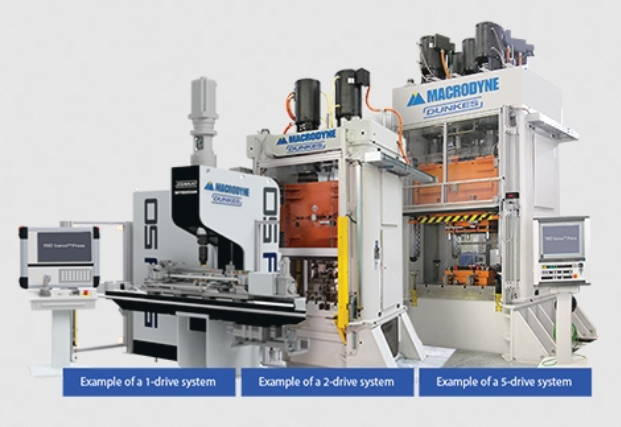
Servo presses take force application a step further by decoupling motion from fixed mechanical behavior.
Instead of inheriting a predefined force curve, servo presses allow manufacturers to program how force builds, holds, and releases throughout the press stroke. Force, position, and speed are all actively controlled.
With servo technology, press force can be:
- Applied earlier in the stroke
- Shaped to match material behavior
- Held at a specific load
- Adjusted cycle-to-cycle as conditions change
This level of control is especially valuable for advanced materials, complex geometries, and processes where minor force variations can create defects or tool damage.
Bottom Dead Center Isn’t Always the Answer
Many manufacturing discussions revolve around force at Bottom Dead Center (BDC). While BDC is critical for some operations, it’s not where all forming work occurs.
Processes like drawing, forming, and straightening often demand force well before BDC and sometimes require force to be sustained across a significant portion of the stroke length.
Hydraulic and servo presses excel here because they do not rely on positional mechanical advantage. Force is available where the process needs it—not just where the machine geometry allows it.
Impact on Tooling and Part Quality
Force application directly affects:
- Die wear patterns
- Material flow
- Surface finish
- Dimensional consistency
Abrupt force spikes increase localized stress and accelerate tooling failure. Smooth, controlled force application reduces galling, stabilizes material deformation, and extends die life.
In many cases, tooling life can vary dramatically based solely on how force is applied, even when peak tonnage remains unchanged.
Energy Use and Usable Energy
Press selection is also an energy decision.
Usable energy is not the same as rated tonnage. It’s the energy available to do forming work across the stroke. A press can meet tonnage requirements and still fail to deliver enough energy to complete the operation consistently.
Hydraulic and servo presses allow energy to be applied precisely where work is being done, reducing wasted motion and unnecessary loading. This improves process efficiency and supports lower total cost of ownership over time.
Stroke Length, Ram Stroke, and Process Matching
Stroke length and ram stroke settings influence:
- Where force is applied
- How energy is consumed
- How controllable the process remains
Being able to tailor the press stroke to the actual working window reduces cycle time, improves consistency, and minimizes unnecessary system loading. This is particularly important in long-stroke forming and drawing applications.
Choosing the Right Press Starts With the Force Curve
Understanding press force throughout the stroke isn’t academic. It’s how stable processes are built, tooling life is protected, and production stops being reactive. When the force profile matches what the material actually needs, plants see fewer unplanned stoppages (equipment failure accounts for 80% of all unplanned downtime in manufacturing), less scrap, and longer tool life.
Successful press selection begins with understanding:
- Where force is required in the stroke
- How long force must be sustained
- How sensitive the material is to force changes
- How much flexibility the process demands
Rather than asking, “What tonnage do we need?” the better question is: “What force profile does this process require?”
Hydraulic and servo presses provide the control, consistency, and adaptability needed to answer that question accurately.
When presses are specified by tonnage alone, problems are inevitable, not because the press is undersized, but because the force arrives at the wrong time.
“The most reliable lines we see aren’t the ones with the biggest presses,” says Fernandes. “They’re the ones where the force profile actually matches what the material needs.”
Understanding press force throughout the stroke isn’t academic. It’s how stable processes are built, tooling life is protected, and production stops being reactive.