Why the Lowest Bid is Often the Highest Risk
Selecting the right industrial equipment is rarely a matter of finding the lowest price on a spreadsheet. Anyone who has ever inherited a “great deal” from the previous plant manager already knows that.
It’s an exercise in risk management and long-term asset planning.
For manufacturing leads and procurement engineers, the process of sourcing hydraulic presses is frequently plagued by a “Procurement-Engineering Gap.” While procurement departments often prioritize the upfront cost, engineering teams must live with the performance and reliability of the machine for decades. The lowest bidder tends to disappear from the conversation right around the time the troubleshooting begins.
To avoid the hidden costs of subpar equipment, it’s key to look past the quote and evaluate the machine as a production partner rather than a commodity.
Shifting from Procurement to Engineering-First Decision Making
The common trap in sourcing hydraulic presses is treating the machine as a static, interchangeable tool.
In reality, every press is a dynamic system.
“A press doesn’t operate in isolation,” says Kevin Fernandes, President of Macrodyne Technologies. “The way force, speed, motion, controls, tooling, and automation interact under load is what ultimately determines whether a system performs reliably in production.”
A focus on “engineering-first” decision-making means evaluating the equipment based on its total cost of ownership (TCO) and its ability to meet specific production tolerances over its lifecycle.
Instead of merely comparing list prices, engineers must audit the manufacturing process of the press itself.
Ask for proof of structural testing, component origins and documentation quality. A machine with a slightly higher upfront cost often yields a significantly lower lifetime cost due to reduced downtime, easier maintenance and higher precision in metal forming or molding tasks. That matters when unplanned downtime can cost manufacturers an average of $260,000 per hour, with total annual losses across U.S. manufacturing estimated at roughly $50 billion.
Why Basic Specs are Deceptive
Many manufacturers lead with the “tonnage” or “force” rating as the primary selling point.
While tonnage is essential (obviously, physics still has standards), it’s often a deceptive metric when viewed in isolation.
A machine might be rated for 500 tons, but if the frame deflects excessively under that load, the tonnage becomes irrelevant because the product produced will fail to meet tolerance requirements. Hitting force targets means very little if dimensional consistency disappears the moment the ram contacts material.
Force is only one half of the equation. The structural geometry provides the repeatability.
Always ask for the “Maximum Frame Deflection at Full Tonnage” and ensure the press is rated for continuous, rather than intermittent, duty at that force. There is a significant difference between briefly touching a force target and surviving years of real production at it.
Understanding Frame Rigidity and Maximum Frame Deflection
Structural rigidity is the foundation of precision manufacturing.
When a press applies force, the frame undergoes stress. If the design is insufficient, the frame will “breathe,” or flex, under load. This deflection leads to inconsistent part quality, uneven pressure distribution across the tooling, and premature wear on machine components.
A reputable manufacturer will be able to provide finite element analysis (FEA) data demonstrating how their frame reacts under peak pressure. High-rigidity frames are non-negotiable for precision molding or deep-draw metal forming.
Geometric Distortion and Its Impact on Tooling Life
Geometric distortion occurs when the ram and the bolster plate lose parallel alignment under load. Even a fraction of a millimeter of misalignment can ruin expensive, custom-machined tooling.
This distortion causes “side-loading,” which wears down seals and guide bushings rapidly.
When auditing a manufacturer, you should inquire about the guidance systems. Are they using hardened steel or replaceable brass liners? Superior guidance systems prevent tilt and ensure that the force is applied perfectly perpendicular to the workpiece throughout the entire stroke length.
Load-Level Machine Behavior
Stability is determined by the balance between the hydraulic force and the mechanical resistance of the frame.
In high-volume environments, you need a press that exhibits consistent behavior across varying load levels. If a press behaves differently at 20% tonnage than it does at 90% tonnage, your process windows will be unstable.
Evaluate the machine’s ability to maintain pressure profile consistency across the full range of its operation.
Choosing the Right Frame for the Job
H-Frame and Four-Column Presses
For high-tonnage requirements where stability is paramount, the H-Frame or four-column design is the industry standard. These designs distribute force evenly, minimizing the risk of tipping or plate deflection.
If your application involves heavy-duty metal forming or high-pressure molding, the four-column design is generally superior due to its inherent symmetry, which ensures that even if the load is slightly off-center, the ram remains stable.
C-Frame and Movable-Table Versatility
C-Frame presses offer the advantage of three-sided access, which is ideal for assembly tasks, specialized metal forming, or jobs requiring frequent tool changes. However, they are inherently more prone to deflection than H-Frame designs. If your manufacturing needs require a C-Frame, ensure the manufacturer has compensated for the “open-throat” design with heavy-duty reinforcements. A quality C-Frame press should be specifically engineered to resist the twisting moments that are absent in closed-frame configurations.
Ram Platen Design and Workbed Tolerance
The ram platen and the workbed must be precision-machined to ensure that tooling is supported uniformly.
Look for manufacturers that use stress-relieved steel plates and precision-ground surfaces.
The flatness of the bed is a critical indicator of machine quality. A manufacturer that ignores bed flatness will likely ignore other precision markers, leading to significant headaches during production ramp-up.
Beyond Pascal’s Law
Evaluating Piston Rods, Brass Guides and Seals
The longevity of a press is dictated by its hydraulic components.
High-quality piston rods, wear-resistant seals and heavy-duty brass guides are the difference between a machine that runs for years and one that leaks fluid within months.
Seals are the “Achilles’ heel” of hydraulic systems. Request documentation on the seal type and replacement intervals. High-grade seals, combined with precision-machined surfaces, significantly reduce the frequency of maintenance cycles.
Hydraulic Reservoirs, Cooling Systems and Filtration
The hydraulic fluid is the “blood” of the machine. If it becomes contaminated or overheated, every downstream component suffers.
An entry-level machine may lack an adequate cooling system, leading to oil degradation and viscosity issues.
Ensure the press includes a robust oil-to-water or air-to-oil heat exchanger and high-efficiency filtration systems. Proper cooling and filtration aren’t luxury features. They are mandatory for extending the life of your pumps and valves.
Relief Valves and Pressure Gauges
Precise control of hydraulic pressure is essential for manufacturing consistency. Proportional relief valves allow for repeatable, accurate force settings, which are critical in sensitive composites and molding applications.
Ensure the press is equipped with digital pressure transducers and high-quality gauges that allow operators to monitor performance in real-time, moving away from archaic analog methods that offer little insight into process health.
Automation as a Production System
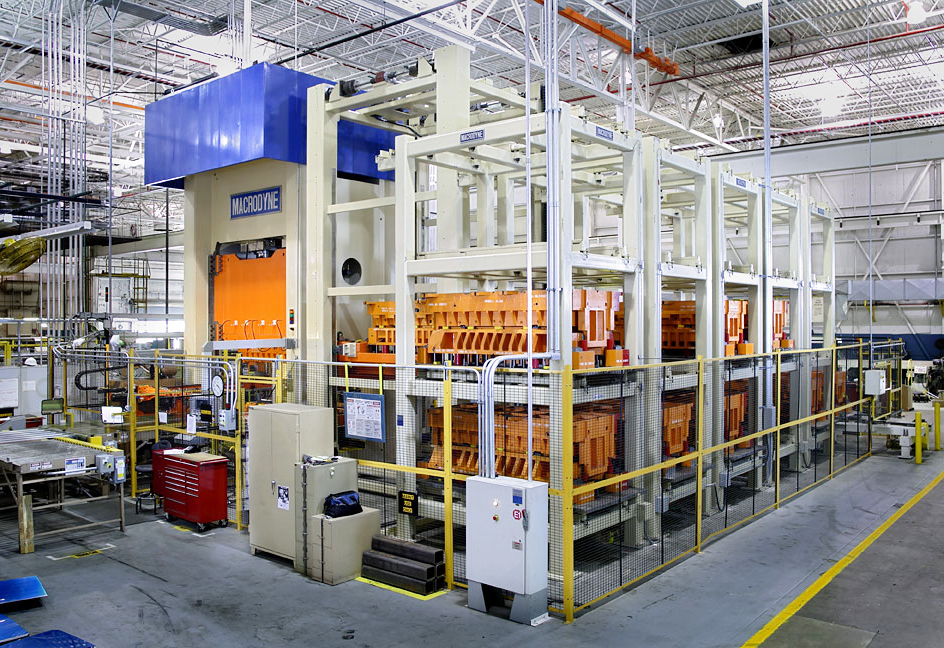
Automation is no longer just a productivity upgrade. In many industries, it has become essential for maintaining throughput, repeatability and labor stability at scale. “The challenge today is not simply automating a process,” says Jeff Walsh, Macrodyne Director of Business Development. “It’s maintaining process stability and production consistency as volumes increase and systems become more interconnected.”
However, successful automation depends heavily on the behavior of the press itself. Even sophisticated robotic systems struggle when paired with inconsistent ram motion, unstable pressure profiles or poorly synchronized controls architectures.
PLC Controls and Touchscreen HMI
The controller is the brain of the operation. A modern PLC system should allow for easy setup of pressure profiles, stroke length limits, and multi-stage cycles.
However, complexity should not come at the expense of usability. The HMI (Human-Machine Interface) should be intuitive, allowing operators to save and recall job recipes, which significantly reduces setup time and human error during changeovers.
Automation Integration
For high-volume manufacturing, the press must be “automation-ready.” This means it needs to provide clean, reliable I/O integration for robotic arms, part conveyors and automated loading/unloading systems.
If you plan to scale, consider how easily the machine can communicate with your existing factory network. The ability to trigger cycles based on external sensor feedback is vital for modern, lights-out production environments.
The Hidden Risk of Multi-Vendor Integration
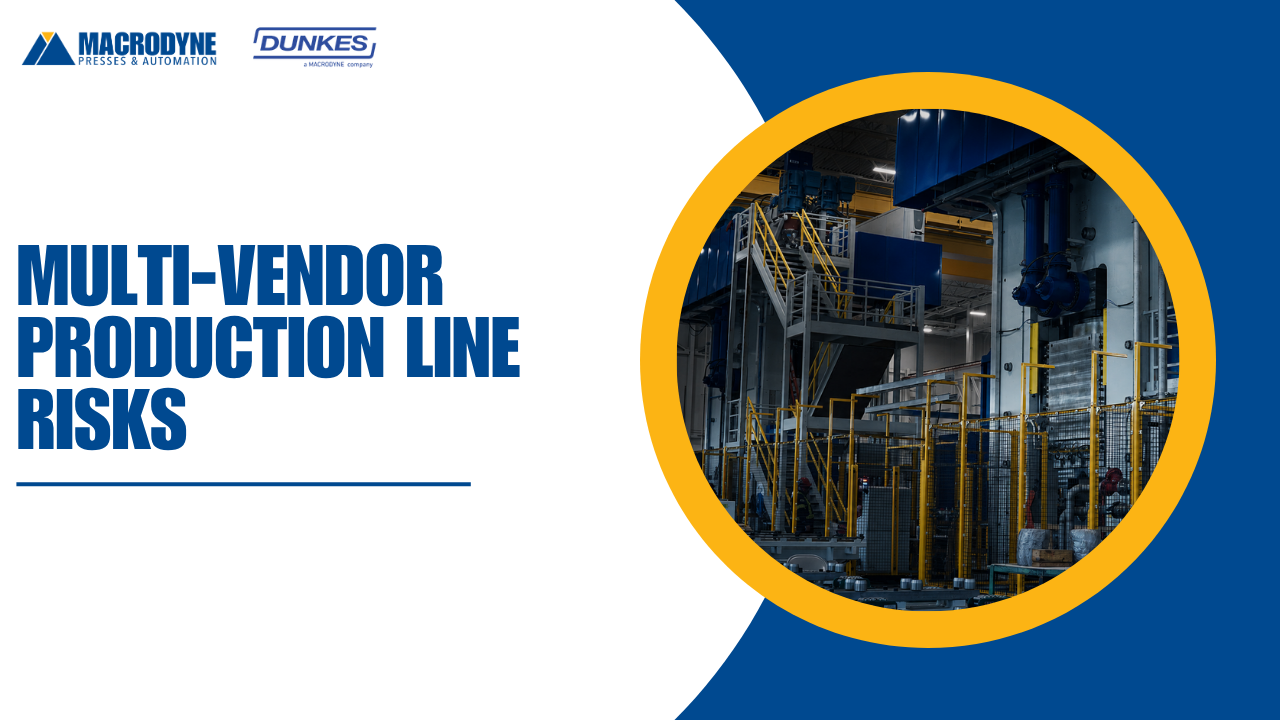
One of the most overlooked risks in modern manufacturing is fragmented system responsibility. In many facilities, the press manufacturer, robot integrator, tooling supplier, controls provider and conveyor vendor all operate independently.
On paper, the system appears complete. In reality, manufacturers are often left managing the integration risk themselves.
When problems emerge, each vendor may point to another subsystem as the source of the issue. The press supplier blames the robot timing. The automation provider blames inconsistent press motion. The tooling supplier blames part presentation.
This fragmentation creates delays, instability and prolonged troubleshooting during production ramp-up.
In high-volume manufacturing environments, synchronized system behavior is critical. The press cycle, material handling, tooling engagement, transfer motion and safety architecture must all operate as a coordinated system rather than isolated components. This has become particularly important in defense manufacturing, where aggressive production targets and rapidly expanding capacity requirements leave little room for process instability or prolonged commissioning delays.
This is why many manufacturers increasingly prioritize single-source responsibility for press and automation systems. A unified controls architecture allows motion profiles, pressure curves, robotic timing and sensor feedback to be engineered together from the beginning, significantly reducing commissioning risk and long-term operational instability.
As manufacturers move toward higher-volume production environments, automation is no longer optional. The challenge is not simply automating the process, but maintaining consistency while throughput increases. Poorly integrated systems often become unstable as cycle times accelerate.
Future-Proofing for Industry 4.0 and Remote Diagnostics
Industry 4.0 isn’t just a buzzword. It is a way to reduce downtime.
Look for manufacturers that offer remote diagnostics as standard. Being able to allow a technician to remotely troubleshoot a faulty valve or a software error can save days of production time.
Future-proofing your investment means choosing a manufacturer that updates their control firmware and offers modular add-ons to keep your equipment relevant for the next decade.
Safety Compliance as a Performance Metric
ISO 13849 Standards and Safety Interlocks
Safety is the most critical aspect of any manufacturing process.
Your press should feature redundant safety interlocks that ensure the machine cannot cycle if a guard is open or a light curtain is triggered. Never treat safety as an add-on. It must be baked into the architecture of the control system.
Safety Light Curtains and Operational Ergonomics
Operational safety must also consider ergonomics. Safety light curtains should be positioned to protect the operator without impeding the loading process. Ergonomics play a role in safety. If a machine is difficult to load, workers may develop “work-arounds” that compromise safety protocols. A well-designed machine makes safe operation the easiest path for the operator.
Redundancy in Hydraulic Valves and Control Systems
Redundancy in hydraulic valves ensures that if one valve fails, the system enters a safe, depressurized state.
Avoid manufacturers that skimp on dual-channel valve systems. Your risk assessment must demand hardware-based safety overrides that operate independently of the primary PLC, ensuring that the machine is physically incapable of accidental movement.
The Manufacturer Audit
Spare Parts Traceability and Inventory Reliability
A machine is only as good as the availability of its components. If a seal fails and the manufacturer tells you it is a custom part with a six-week lead time, your production line is effectively dead.
Audit the manufacturer’s spare parts policy. Do they provide an itemized list of components, and are these components “off-the-shelf” or proprietary? Proprietary parts are a red flag for a “vendor-lock” strategy that will cost you significantly more in the long run.
Local Technical Support vs. Remote Diagnostics Speed
Where is the manufacturer located, and where are their technicians based? Remote diagnostics are excellent, but there is no substitute for a technician on the factory floor if a catastrophic failure occurs.
Evaluate their response time metrics and their availability of field service technicians. A manufacturer with a robust local support network is worth a premium compared to an overseas supplier with no domestic infrastructure.
Evaluating Lead Times and Production Milestone Transparency
The procurement process should include clear milestones: design approval, material sourcing, fabrication, factory acceptance testing (FAT), and shipping.
A reputable manufacturer will invite you to witness the FAT, where you can verify the press performance before it leaves their facility. If a manufacturer is vague about milestones, it is a sign of poor project management that will likely spill over into machine quality.
Total Cost of Ownership
Energy Efficiency and Power Consumption in High-Volume Production
In high-volume manufacturing, the electricity cost to run a hydraulic pump can be astronomical.
Modern presses now feature Variable Frequency Drives (VFDs) and servo-hydraulic systems that only draw power when the ram is in motion or under load.
Investing in a VFD-controlled machine can reduce energy consumption by 30% to 50%. Calculate your electricity savings over a five-year period to determine if the initial price premium of an efficient system is actually a net saving.
Conclusion
Evaluating a hydraulic press manufacturer is a discipline of deep research and skepticism.
By shifting focus from the “tonnage” label to structural rigidity, component quality, and organizational reliability, you transform the purchasing process from a gamble into a strategic investment.
Remember that the quote is merely the first chapter of the story. The true cost of the machine is written in the maintenance logs, the uptime percentages and the safety records over the years to come.
Prioritize manufacturers who offer transparency in their engineering.
Utilize a weighted evaluation matrix, assigning scores for structural rigidity, support infrastructure, control capabilities, and energy efficiency, to standardize your comparisons.
By doing so, you ensure that your facility is equipped not just with a piece of metal, but with a reliable, efficient engine of production that will provide a competitive advantage for years to come. The goal is to move beyond the price tag and secure the long-term health of your production floor.
Bonus Section
Questions Experienced Manufacturers Ask Before Buying a Hydraulic Press
A hydraulic press should not be evaluated as a standalone machine or a line item on a spreadsheet. It should be evaluated as a long-term production system. The following questions can help identify potential risks before they become production problems.
- What Happens When Something Breaks?
- Who actually services this machine?
- Where are your technicians located?
- What is your average response time?
- Are spare parts stocked locally?
- Can you support this machine 10 years from now?
Keep in mind: Downtime is rarely caused by a catastrophic failure. More often, it’s caused by waiting on support, documentation, or parts.
- Can the Machine Hold Tolerances Under Real Production Conditions?
- What is maximum frame deflection at full tonnage?
- How does the machine behave under off-center loading?
- Is the press rated for continuous or intermittent duty?
- Can you provide repeatability data?
Keep in mind: A press can hit tonnage targets and still produce inconsistent parts.
- Who Owns the Integration Risk?
- Who is responsible for the press, automation and controls integration?
- Is this a unified controls architecture?
- What happens if the robot timing and press motion conflict?
- Who troubleshoots the system during commissioning?
Keep in mind: The fastest way to lose weeks during startup is having multiple vendors blaming each other.
- What Does Maintenance Actually Look Like?
- Are components proprietary or off-the-shelf?
- What are typical seal replacement intervals?
- How accessible are valves, pumps and filters?
- Can maintenance be performed without major teardown?
Keep in mind: Every manufacturer promises reliability. Very few discuss maintenance access honestly.
- Is the Machine Designed for Real Production or Demonstration Cycles?
- How does the machine behave at high cycle rates?
- What changes under sustained production loads?
- Has this design been proven in similar applications?
- Can we witness FAT testing?
Keep in mind: Many systems look stable during demonstrations. Production exposes weaknesses quickly.
- What Will This Machine Cost Me Five Years From Now?
- What is the expected energy consumption?
- What components historically fail first?
- How often are firmware/software updates required?
- What is the expected lifecycle of the hydraulic system?
Keep in mind: The cheapest quote is often the most expensive long-term decision.
Final Thought
A hydraulic press should not be evaluated as a standalone machine.
It should be evaluated as a long-term production system that must behave predictably under load, at volume, under pressure, for years to come.