
Military ammunition procurement operates under a centralized framework for a reason: fragmentation fails under pressure.
The Single Manager for Conventional Ammunition system reflects the Department of Defense’s need for control, consistency, and accountability across one of its most sensitive supply chains.
Single-source responsibility in ammunition lines means one entity owns the outcome end to end. From raw material sourcing through to final delivery, there is no ambiguity around who is responsible when something works… or when it doesn’t.
“In ammunition manufacturing, the risk usually doesn’t come from one major failure,” says Jeffrey Walsh, Director of Business Development with Macrodyne Technologies. “It comes from the handoffs. Different machines, different suppliers, different assumptions. When one source is responsible for the full line, those gaps get closed.”
This is not vendor consolidation. It is operational discipline.
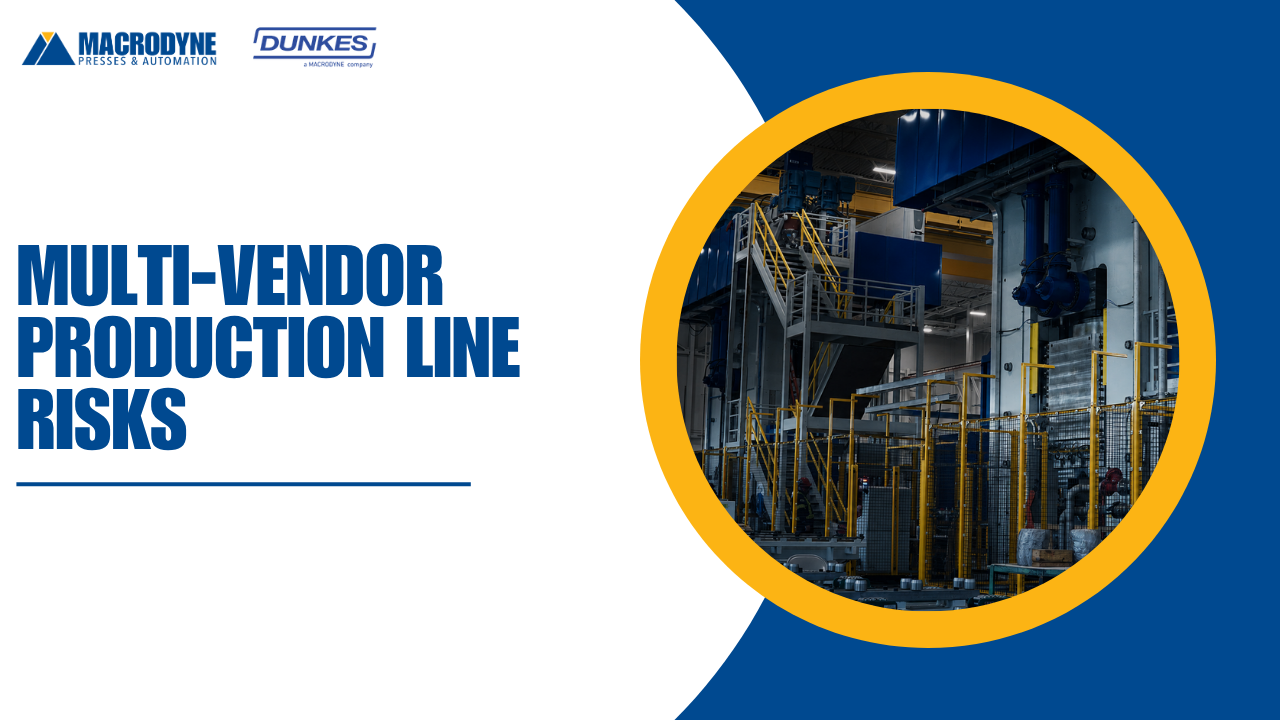
When multiple suppliers own different parts of the process, variability creeps in. Different interpretations of specs, inconsistent quality standards and blurred accountability. When one entity owns the full system, problems are traceable and corrective actions actually stick.
As ammunition production scales and interoperability across military branches becomes non-negotiable, this model stops being a preference. It becomes infrastructure.
This centralized approach has become increasingly vital as munitions operations require unprecedented interoperability across military services. Rather than each branch managing separate supply chains that might create compatibility issues, single-source responsibility creates the foundation for seamless ammunition integration across all combat scenarios.
Understanding how this responsibility structure delivers tangible operational advantages reveals why military procurement has evolved toward this consolidated model.
Key Benefits of Single-Source Responsibility
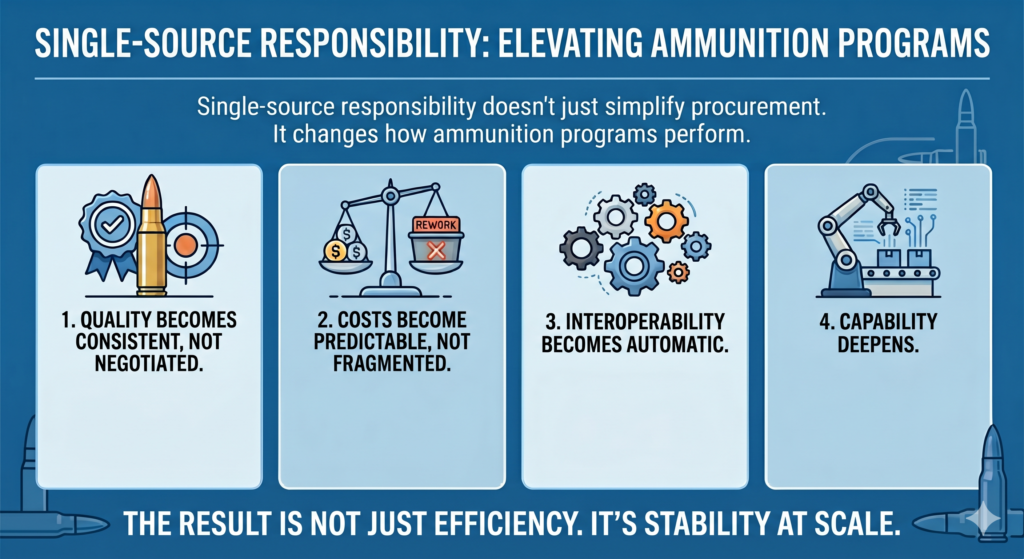
Single-source responsibility doesn’t just simplify procurement. It changes how ammunition programs perform.
Quality becomes consistent, not negotiated.
One entity defines and enforces standards across the entire line. No reinterpretation. No drift between suppliers. Every round meets the same expectation.
Costs become predictable, not fragmented.
Yes, unit pricing can look higher on paper. But fragmented systems hide costs in rework, delays, coordination failures, and redundant validation. Single-source removes that noise.
Interoperability becomes automatic.
When production is unified, compatibility issues disappear. Ammunition performs the same across units, systems, and deployment scenarios.
Capability deepens.
A single responsible source invests differently. Tooling, automation, process control—these become long-term decisions, not short-term bids.
The result is not just efficiency. It’s stability at scale.
“Ammunition lines are not the place for blurred responsibility,” says Kevin Fernandes, President of Macrodyne Technologies. “If you want predictable output, consistent quality and lower integration risk, someone has to own the full system.”
Enhanced Supply Chain Security
Single-source responsibility reduces exposure across the ammunition supply chain. That’s the objective.
Every additional supplier interface introduces risk. Quality drift, delays, misalignment, or security vulnerabilities. Consolidating responsibility under a single authority removes those weak points and creates a more controlled, predictable system.
This has direct implications for the ammunition industrial base.
A fragmented approach places strain on the industrial base by creating inconsistent demand signals, competing specifications, and uneven production requirements. Suppliers are forced to react rather than plan, which limits their ability to invest in capacity, workforce and long-term capability.
Single-source responsibility changes that.
With one coordinating authority:
- Demand becomes more predictable
- Production planning stabilizes
- Suppliers can invest with confidence
The result is a stronger, more resilient ammunition industrial base. One that is better equipped to support both steady-state production and surge requirements.
Security protocols also become more enforceable. Supplier vetting, material traceability, and quality standards are applied consistently across the entire system, rather than interpreted differently across multiple procurement channels.
This reduces the likelihood of substandard materials entering the supply chain and strengthens overall system integrity.
Security, in this context, isn’t just about protection. It’s about control, consistency, and the ability to respond without hesitation when it matters most.
Challenges and Considerations
Single-source responsibility isn’t without tradeoffs. But most of the “risks” are misunderstood.
Cost pressure
Yes, pricing can increase without competitive bidding. But focusing on unit cost alone misses system-level cost such as delays, failures, requalification, and coordination overhead.
Dependency risk
This is real, but manageable. Strong suppliers build redundancy into their own operations. The risk is not “single supplier.” The risk is selecting the wrong one.
Regulatory complexity
Compliance requirements don’t disappear. But they become centralized and consistent instead of fragmented and duplicated.
The takeaway is simple: The model only works if the supplier is capable of carrying the responsibility. That’s where supplier selection becomes critical. Not just for equipment, but for full-system responsibility across forming, automation and integration.
For a deeper look at how these systems are designed and delivered in defense manufacturing environments, see our work in Macrodyne defense manufacturing solutions page.
“Single-source responsibility only works if the source is actually capable,” says Fernandes. “This is not about awarding more scope. It is about assigning accountability to an organization that can engineer and integrate the full line.”
Common Misconceptions About Single-Source Responsibility
Despite its proven benefits, single-source responsibility faces several persistent misconceptions that can hinder its adoption in ammunition procurement strategies.
“It Creates Dangerous Dependencies” The most common concern is that relying on one supplier creates vulnerability. However, this misunderstands the concept entirely. Single-source responsibility doesn’t mean single-source manufacturing. It means one entity coordinates and takes accountability for the entire ammunition line while potentially using multiple sub-suppliers. The responsible party maintains redundant capabilities and backup plans.
“It’s More Expensive Than Competition” While initial costs might appear higher, this view ignores long-term value. Single-source approaches eliminate costly quality inconsistencies, reduce testing and validation expenses, and streamline logistics. When factored into a comprehensive production base strategic plan, the total cost of ownership typically decreases significantly.
“It Stifles Innovation” Critics argue that removing competition reduces innovation incentives. In practice, the opposite often occurs. When suppliers have long-term relationships and clear accountability, they invest more heavily in research and development. They can focus on continuous improvement rather than short-term competitive positioning.
“It’s Just Favoritism” Some view single-source contracts as politically motivated rather than performance-based. However, legitimate single-source decisions follow rigorous evaluation criteria including technical capability, production capacity, quality systems, and past performance. The DoD Instruction 5160.68 establishes clear guidelines for when single-source arrangements are appropriate and beneficial. Understanding these misconceptions helps organizations make informed decisions about ammunition procurement strategies, setting the stage for important legal and compliance considerations.
Legal and Ethical Considerations
When implementing single-source responsibility for ammunition procurement, organizations must navigate a complex landscape of legal requirements and ethical obligations. Understanding why single-source for defense ammunition extends beyond operational benefits requires examining the regulatory framework that governs munitions handling and procurement decisions.
The legal foundation begins with federal ammunition regulations, where 18 U.S. Code § 921 establishes fundamental definitions that affect how ammunition suppliers must be licensed and monitored. Organizations choosing single-source arrangements must ensure their selected vendor maintains proper federal firearms licensing and complies with all applicable statutes governing ammunition manufacturing and distribution.
Storage and handling requirements present another critical consideration. The UFC 4-420-01 standard outlines specific requirements for ammunition and explosive storage facilities, creating legal obligations that single-source vendors must meet consistently across all delivery locations. This standardization actually supports the single-source model by ensuring uniform compliance protocols.
Ethically, organizations must balance cost efficiency with responsible sourcing practices. Single-source arrangements create dependency relationships that require careful vendor evaluation to ensure sustained quality, safety standards, and fair pricing practices. The concentration of supply responsibility demands higher due diligence standards and ongoing performance monitoring to maintain ethical procurement practices while achieving operational objectives.
Frequently Asked Questions

Q: How does single-source responsibility differ from traditional multi-vendor procurement?
A: Traditional procurement often involves multiple suppliers for different components or services, creating coordination challenges and accountability gaps. Single-source responsibility consolidates oversight under one entity, streamlining ammunition issue procedures and establishing clear accountability chains. This approach reduces administrative burden while improving traceability throughout the supply chain.
Q: Does single-source responsibility increase costs compared to competitive bidding?
A: While initial procurement costs may appear higher without competitive pressure, the total cost of ownership often decreases significantly. Organizations eliminate duplicate administrative processes, reduce quality control expenses, and minimize costly delays from coordination failures. The streamlined management structure typically generates savings that offset higher unit costs.
Q: What happens if the single source experiences production problems?
A: Effective single-source contracts include robust contingency planning and performance guarantees. The designated source must maintain backup production capabilities and supply chain redundancies. However, this represents a calculated risk – the improved coordination and accountability often prevent problems that would be more difficult to resolve across multiple vendors.
Q: Can single-source responsibility work for specialized ammunition requirements?
A: Specialized applications actually benefit most from this approach, as the designated source develops deep expertise in specific requirements and maintains consistent quality standards throughout the product lifecycle.
Key Single Manager For Conventional Ammunition Takeaways
Single-source responsibility represents a fundamental shift in ammunition procurement strategy that delivers measurable benefits across cost, quality, and operational dimensions. Organizations implementing this approach typically see 15-25% reductions in total procurement costs while significantly improving supply chain reliability and product consistency.
The streamlined accountability structure eliminates the coordination challenges inherent in multi-vendor systems, creating clearer communication channels and faster issue resolution. Quality control becomes more predictable when a single entity manages the entire ammunition supply chain, from manufacturing specifications to final delivery.
For defense organizations managing the U.S. government ammunition stockpile, single-source responsibility offers particular advantages in maintaining readiness standards and ensuring interoperability across military branches. The consolidated approach supports better inventory management and reduces the complexity of coordinating different ammunition types and specifications.
However, success requires careful vendor selection, robust contract terms, and ongoing performance monitoring. Organizations must balance the efficiency gains against potential supply chain vulnerabilities through strategic risk mitigation measures.
The evidence is clear. When properly implemented, single-source responsibility transforms ammunition procurement from a complex logistical challenge into a streamlined, cost-effective operation that enhances organizational readiness and operational capability.