
Understanding Cycle Times & Throughput
Hydraulic presses have been the backbone of manufacturing for decades, trusted for the sheer, controllable force they deliver on every cycle.
The traditional image is one of brute strength; a slow, deliberate application of power. However, raw power is no longer enough. The demand for increased productivity, shorter lead times and greater efficiency has shifted the focus.
Modern hydraulic presses are not just strong. They are engineered for speed.
This evolution is driven by sophisticated hydraulic systems, advanced electronics and intelligent design, transforming them into nimble, high-throughput machines.
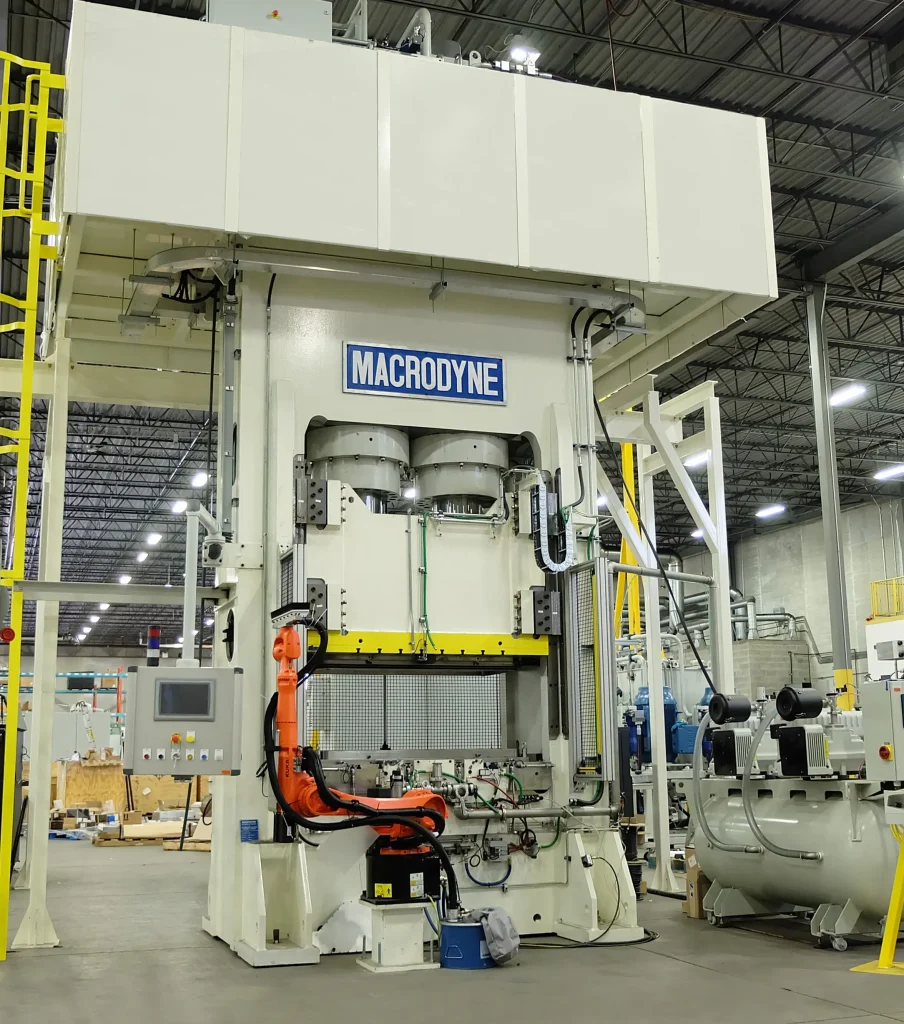
In recent years, OEMs in automotive, defense and aerospace have pushed press builders toward an entirely new performance frontier — not just hitting tonnage, but hitting it faster, with tighter control and higher repeatability. At Macrodyne, this shift has influenced every aspect of our design philosophy: from high-flow hydraulic architectures to servo-integrated motion profiles engineered for minimal non-productive time.
Understanding the factors that govern their speed is now essential for any manufacturer looking to maintain a competitive edge.
This article deconstructs the speed of modern hydraulic presses, exploring the key metrics, the technology driving performance, and how to translate raw speed into tangible production throughput.
Beyond Brute Force
The Need for Speed in Modern Manufacturing
For decades, hydraulic presses were synonymous with immense force. They were the go-to solution for forming, molding and assembling parts that required sheer power. Their reputation was built on tonnage, not time. But the modern manufacturing environment operates on an entirely different clock.
In industries from automotive stamping to aerospace assembly, the pace of production is relentless. The question is no longer just “how much force can it apply?” but “how many quality parts can it produce per hour?” This shift has propelled the need for speed to the forefront of press technology. In some defense production programs specifically, manufacturers are being asked to more than triple manufacturing capability within 2-3 years.
“You don’t win on force anymore. You win on throughput,” says Jeffrey Walsh, Director of Business Development with Macrodyne Technologies. “A press that’s fast, predictable and easy to automate drives more value than a bigger machine running old logic.”
Innovations Driving Modern Hydraulic Presses
The impressive speeds of today’s hydraulic presses are not accidental. They are the result of decades of innovation in hydraulic components, control systems and mechanical design.
Advanced Hydraulic Circuitry for Faster Cycles
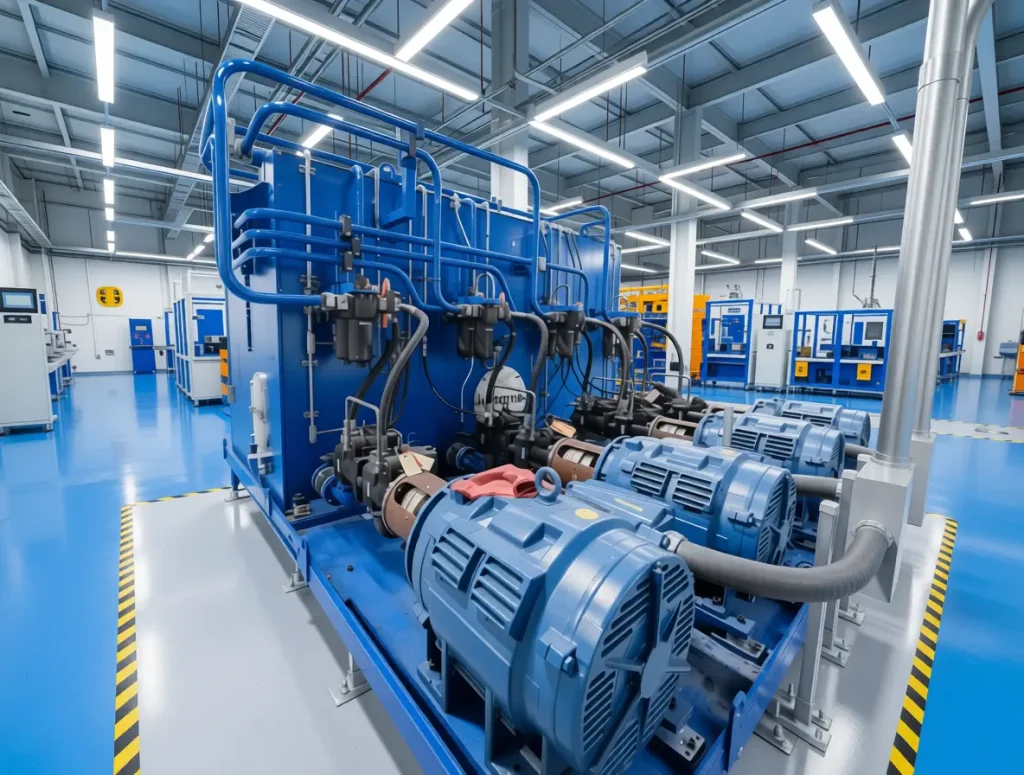
Modern hydraulic press circuits are far more sophisticated than simple pump-and-cylinder setups. They employ logic elements, pre-fill valves, and regenerative circuits.
Pre-fill valves allow large volumes of hydraulic fluid to flood the main cylinder during the rapid advance, dramatically increasing approach speed. Regenerative circuits redirect fluid from the rod side of the hydraulic cylinder to the piston side during extension, effectively multiplying the flow from the hydraulic pump to achieve faster non-working strokes without needing a larger, more expensive pump.
Macrodyne designs all hydraulic power units and manifolds in-house, allowing us to engineer high-flow paths, minimized pressure drop and regenerative motion profiles specifically for the application, not generic catalog components.
Precision Control Systems: Orchestrating Motion
The “brains” of a modern press are its electronics. Programmable Logic Controllers (PLCs) and Human-Machine Interfaces (HMIs) allow for precise orchestration of every cycle phase. They can program variable ram speeds, exact positional stops, and precise pressure control. More advanced servo-hydraulic systems use feedback from sensors to make real-time adjustments to valve positions and pump output, achieving exceptionally high levels of speed, accuracy, and repeatability that were once impossible.
Energy-Efficient Power Units & Drives
The hydraulic power unit is the heart of the press. Modern units are designed for both speed and efficiency. Variable Frequency Drives (VFDs) can adjust the speed of the electric motor powering the hydraulic pump, matching output to the immediate demand of the cycle. This means the pump runs at full speed during rapid movements but slows down during dwell or idle periods, saving significant energy and reducing heat buildup in the hydraulic fluid, which in turn ensures consistent performance.
Press Design Enhancements for High-Speed Operation
Speed places immense stress on the physical structure of a press. To accommodate faster cycles, modern press frames are designed using Finite Element Analysis (FEA) to ensure rigidity and minimize deflection even under rapid, high-tonnage loading. Gib guiding systems are engineered with low-friction materials and precise tolerances to ensure smooth, accurate ram travel at high velocities, preventing premature wear and maintaining part quality over millions of cycles.
From Speed to Throughput: Maximizing Production Efficiency
A fast press is only one part of a productive manufacturing ecosystem. True efficiency is achieved when that speed is effectively translated into consistent, high-volume output of quality parts.
Automation and Material Handling
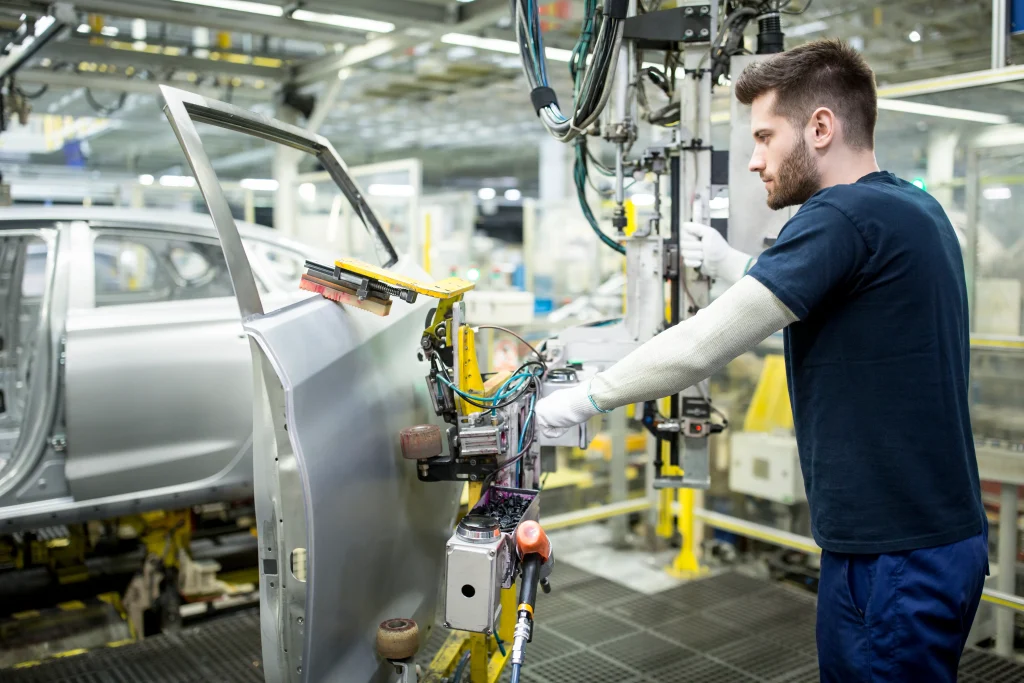
Integrating automation is the key to unlocking a press’s full throughput potential. Automated systems such as robotic arms, coil feeders, and transfer systems can load and unload parts far faster and more consistently than a human operator. This synergy ensures that the press isn’t left waiting for the next workpiece, allowing it to run at its optimal cycle time continuously and dramatically increasing overall productivity.
This is where Macrodyne’s turnkey automation — robotics, transfers, feeders and integrated QC — becomes a force multiplier. A fast press without fast handling is a bottleneck; a fast, integrated system is a competitive advantage.
Calculating Actual Throughput and Cost Efficiency
To understand the true value of a high-speed press, manufacturers must calculate actual throughput. This involves timing the entire production process and accounting for all variables. By dividing the number of good parts produced by the total time, a real-world output rate is established. This figure can then be used to calculate the cost per part, demonstrating how the higher initial investment in a faster, more automated press can lead to significantly lower production costs and a faster return on investment.
Industry Applications: Speed in Action
The benefits of high-speed hydraulic presses are evident across numerous industries. In the automotive sector, they are used for high-volume stamping of body panels and structural components. In appliance manufacturing, they perform deep drawing operations for items like sinks and washing machine drums. In the electronics industry, they are used for precision forming and assembly of small components, where fast cycle times are critical for meeting consumer demand.
Macrodyne has deployed high-speed systems in:
- Automotive structural and BIW stamping
- Titanium hot/warm forming and SPF in aerospace
- Defense forming systems (e.g., deep-draw lines for ammunition components)
- High-precision appliance deep draw operations
Optimizing for Speed: Practical Considerations and Trade-offs
Pursuing maximum speed requires a balanced approach, as increasing velocity can impact other critical aspects of the pressing operation.
The Speed vs. Force vs. Precision Triangle
These three factors are intrinsically linked. Increasing speed often requires a trade-off with precision, as stopping a fast-moving, heavy ram at an exact position becomes more challenging. Similarly, generating maximum force requires time for pressure to build in the hydraulic system, naturally slowing the pressing stroke. The ideal setup finds the optimal balance for a specific application, achieving the fastest possible cycle time that still meets all force and dimensional tolerance requirements for the part.
Material and Application Specifics
The material being formed and the complexity of the operation dictate the required speed. A simple coining operation may allow for a very fast cycle, while a deep-drawing application with a delicate material requires a slower, more controlled pressing speed to prevent tearing or wrinkling. The press control system must be flexible enough to be programmed for the ideal speed profile for each specific job.
Press Specifications and Selection
When selecting a press, manufacturers must look beyond the maximum SPM. Key specifications to consider include the rapid advance/return speeds (often measured in inches per minute), the pump flow rate (gallons per minute), and the responsiveness of the control system. Choosing a press with specifications that align with the intended application is crucial for achieving desired throughput goals.
Safety and Operator Interface
Higher speeds necessitate enhanced safety measures. Light curtains, safety gates and two-hand controls must be integrated to protect operators from fast-moving components. A modern, intuitive operator interface is also critical, allowing for quick setup and adjustments, which minimizes downtime between jobs and contributes to overall operational efficiency.
Maintaining Speed: Troubleshooting and Best Practices for Consistent Performance
A new press may be fast, but maintaining that speed over its operational life requires diligent maintenance and attention to the health of the hydraulic system.
Common Causes of Speed Degradation
A gradual loss of speed is often a symptom of underlying issues. Common culprits include internal leaks in hydraulic cylinders or valves, a worn hydraulic pump that can no longer deliver its rated flow, clogged filters restricting fluid flow, or hydraulic fluid that has degraded or is at the wrong temperature and viscosity.
Preventive Maintenance for Optimal Speed
A robust preventive maintenance program is essential. This includes regularly changing hydraulic fluid and filters, checking for and repairing leaks, monitoring system pressure and temperature, and inspecting hoses and seals for wear. Keeping the hydraulic fluid clean and cool is one of the most effective ways to ensure consistent speed and prolong the life of all hydraulic components.
System Calibration and Tuning
Over time, the performance of valves and sensors can drift. Periodic calibration of the press’s control system ensures that the programmed speeds, pressures and positions are being accurately executed. Tuning the system, particularly on presses with servo controls, can optimize acceleration and deceleration profiles, shaving valuable fractions of a second off the cycle time while maintaining smooth operation.
The Future of Fast: Smart Presses and Predictive Performance
The quest for speed continues to evolve with the integration of Industry 4.0 technologies.
The next generation of hydraulic presses will be “smart,” equipped with an array of sensors that constantly monitor the health and performance of every component. This data will be analyzed by advanced algorithms to predict when a component, like a hydraulic pump or valve, is beginning to degrade, allowing for maintenance to be scheduled before a failure occurs and before performance is impacted.
This predictive capability, combined with machine learning that can self-optimize cycle parameters, promises a future where hydraulic presses not only operate at exceptional speeds but also maintain that peak performance with unprecedented reliability and intelligence.
Ready to optimize cycle times, throughput, or motion control on your next forming project?
Macrodyne designs and builds high-speed hydraulic press systems engineered for real-world production.
If you’d like to discuss an application or evaluate your current press performance, our team is here to help.